
Overview
Macroeconomic & Traditional Finance Outlook
The FOMC held interest rates steady in October, though strong economic growth has raised expectations of a December rate hike. Treasury yields reached recent highs before easing. Mortgage rates followed suit, peaking before retreating. The U.S. dollar strengthened against major currencies while the euro weakened due to fiscal and political concerns. Equity markets were mixed: AI investment concerns triggered selloffs, but the S&P 500 stayed near record highs as investors remained optimistic about corporate earnings.
Real-World Assets (RWA) Outlook
The U.S. housing market slowed to its weakest pace in 25 years, with sellers cutting prices as inventory rose. Gasoline recorded its largest price increase since the Iran war due to renewed conflict. Gold had its second monthly decline, with high interest rates as a major headwind.
Decentralized Finance (DeFi) Outlook
Crypto trading volumes and ETF flows declined, though tokenized stocks and options moving on-chain gained traction in DeFi. The largest crypto theft occurred on Binance and caused a broader market weakness. On the regulatory side, the OCC finalized its rule implementing the GENIUS Act, setting standards for payment stablecoin issuers ahead of the law taking effect.
RAAC Outlook
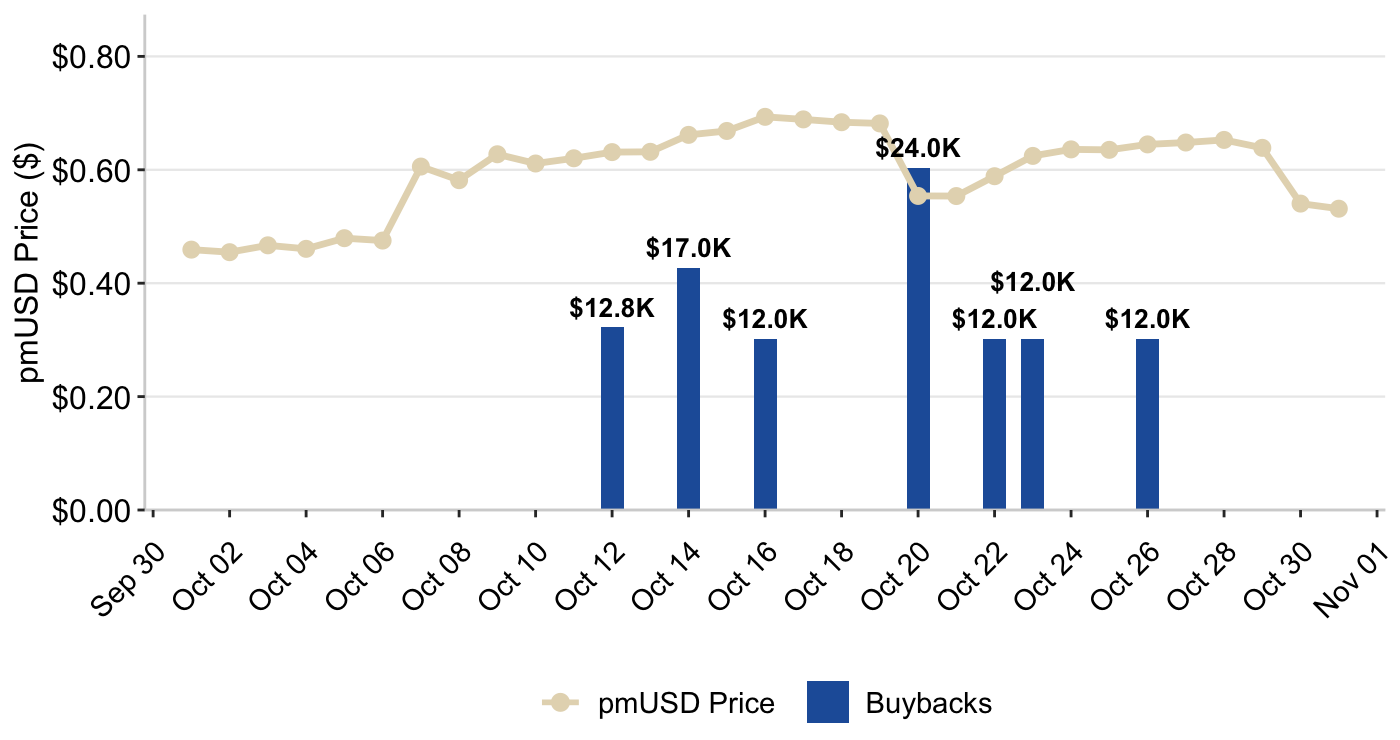
The team started some buybacks to support the pmUSD price, with $101.8K USD worthpurchased. RAAC maintains a healthy collateral level ratio for the pmUSD RW f(x) system and continues to have competitive yields in the Curve liquidity pools.
Macroeconomic & Traditional Finance Outlook
United States
The Federal Open Market Committee (FOMC) voted 10–2 to hold the federal funds rate at 3.75%–4.00%. Chair Kevin Warsh offered no clear indication of whether rates would rise in December, emphasizing that future policy decisions will depend on incoming economic data. Expectations of a December rate hike have increased, although markets are no longer fully pricing in three additional rate increases over the current tightening cycle.
Higher interest rates have emerged as a major market concern in the second half of the year, replacing the Iran war, which dominated sentiment during the first half. The upcoming U.S. midterm elections could add another source of market volatility.
Table 1: U.S. Economic Indicators
| Indicator | Period | Actual | Previous | Consensus |
|---|---|---|---|---|
| GDP | Q3 | 3.4% | 2.2% | 3.2% |
| Unemployment | Sep | 4.2% | 4.1% | 4.1% |
| Core CPI (YoY) | Sep | 2.6% | 2.4% | 2.5% |
| 1YR Inflation Expectations | Oct | 4.7% | 4.6% | 4.7% |
Source: tradingeconomics
U.S. real GDP grew at an annualized rate of 3.4% in Q3, exceeding economists' expectations. Growth was supported by strong business investment and resilient consumer spending. However, inflationary pressures also intensified. CPI rose 0.6% month-over-month, its largest increase since April, while core CPI (excluding food and energy) also exceeded expectations. The increase raised concerns that higher fuel costs are spreading to other goods and services. The Producer Price Index (PPI) rose 1.3% month-over-month, marking its largest monthly increase since March 2022.
The unemployment rate increased to 4.2%, while the labour force participation rate rose to a four-month high of 61.8%. Overall, resilient economic growth and persistent inflation have strengthened expectations of a rate hike in December.
Fed Governor Christopher Waller noted that elevated long-term yields are already weighing on demand in interest-sensitive sectors, effectively doing some of the work of tighter monetary policy.
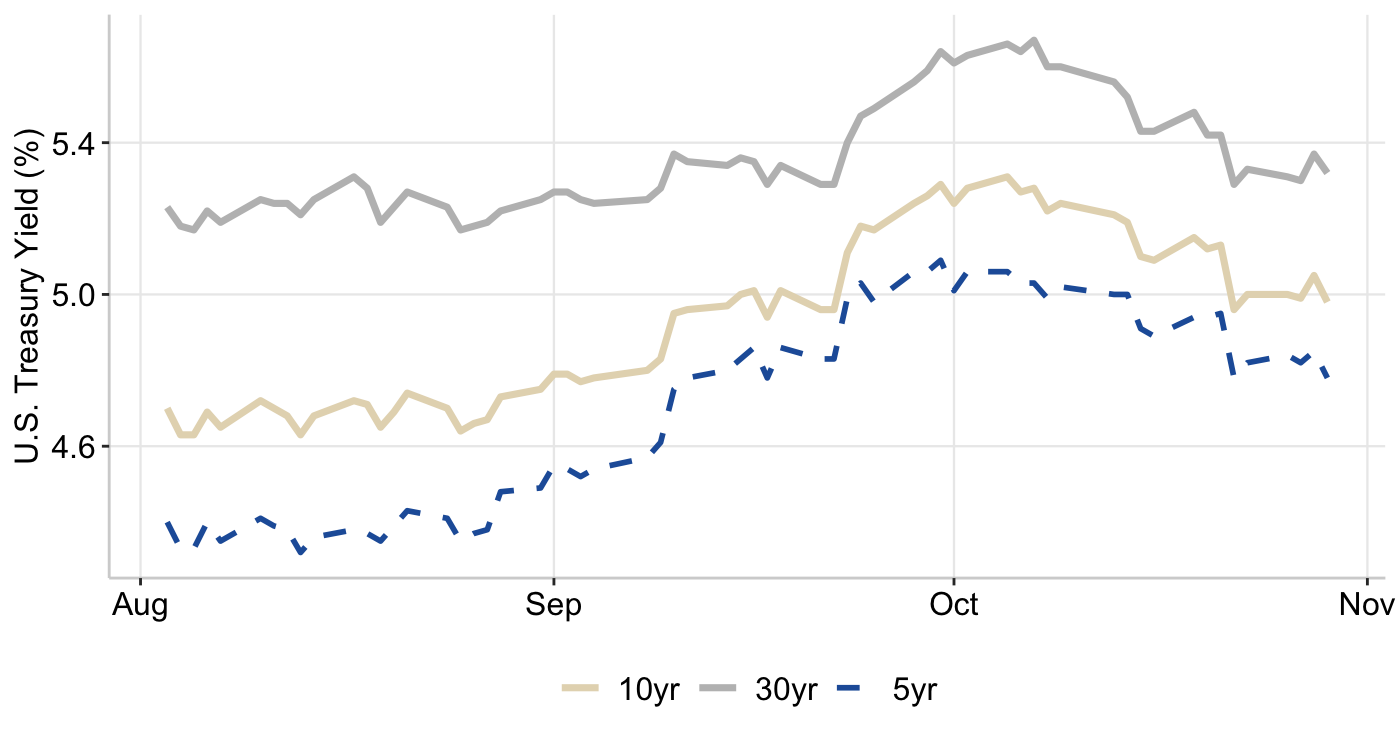
Early in the month, the 10-year Treasury yield reached 5.34%, its highest level since 2002, driven by elevated energy prices, strong AI infrastructure spending and concerns about the U.S. fiscal outlook. Yields subsequently spiked again to 5.03% following the Fed announcement.
The latest CPI report initially pushed short-term yields higher, with the two-year Treasury yield rising by as much as 16 basis points. The five-year yield also exceeded 5.15% for the first time since 2007. However, short-term yields later pulled back, with the two-year yield declining three basis points to 4.71% following the Fed decision.
Graph 1: U.S. 5-Year, 10-Year, & 30-Year Treasury Yields
Source: FRED
Longer-term yields subsequently retreated as investors rotated into government bonds amid technology-sector weakness and growing concerns about AI valuations. The 10-year Treasury yield fell to 4.92%, bringing its October decline to 40 basis points. Strong demand at a U.S. 30-year Treasury auction also helped pull long-term yields back from their highest levels in more than two decades.
With the U.S. fiscal deficit at ~6% of GDP, investors are questioning whether the government has a credible plan to reduce borrowing. Private investors now hold ~70% of U.S. federal debt, near the highest share since 1990. Hedge funds account for around 8.5% of outstanding Treasuries, reflecting a shift away from traditional buyers toward private investors, who are demanding higher yields to hold government debt.
Fiscal concerns are also weighing on international bond markets. The 10-year French government bond yield reached 5% for the first time since 2002, as investors became concerned about the country's fiscal outlook and political instability. European bond-market stress intensified, while the U.K. 30-year gilt yield briefly reached 6%, its highest level since 1998. German government bond yields also came under pressure as political uncertainty contributed to higher risk premiums.
U.S. credit spreads averaged 0.86% during the month, as rising risks associated with AI investment and persistent inflation weighed on sentiment across credit markets. More than $400 billion in corporate bonds have been issued globally this year to finance technology and AI infrastructure projects, increasing competition for investor capital and adding to overall debt supply. Average U.S. high-yield bond yields reached 8.41%, their highest level in 18 months.
U.S. companies issued $106 billion in high-grade and high-yield bonds to finance projects in 2026, nearly three times the $37 billion raised throughout 2025. Investors are concerned that AI infrastructure companies are taking on excessive debt to fund expansion. Credit risk at CoreWeave, an AI data-centre operator, reached an all-time high after the company indicated it was exploring borrowing in investment-grade debt markets. Despite these concerns, hyperscalers and specialized cloud-computing firms are expected to invest nearly $4.5 trillion over the next three years, highlighting the scale of financing required to support continued AI infrastructure expansion.
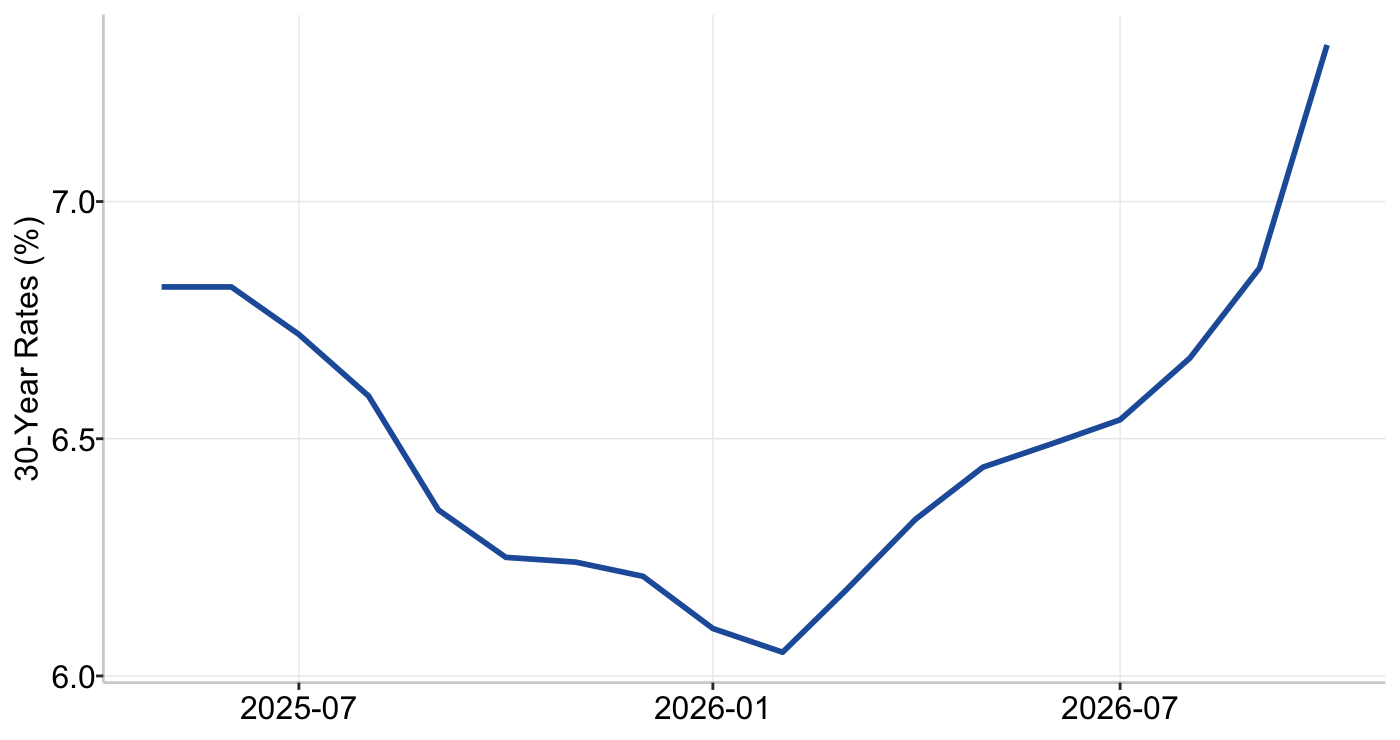
Graph 2: US 30-Year Mortgage Rates
Source: FRED
The average rate on a 30-year fixed mortgage reached 7.50% for the week ending October 9, up approximately one percentage point since the end of June and its highest level since November 2023. Mortgage rates have increased by 1.17 percentage points since the beginning of 2026 and have remained above 7% since last month, adding further pressure to an already strained housing market.
The 30-year fixed mortgage rate climbed 75 basis points over the eight-week period, exceeding the 45-basis-point increase recorded during the comparable period in 2021. Rates eased toward the end of October, declining to 7.24%. However, the Mortgage Bankers Association does not anticipate significant mortgage-rate declines over its forecast horizon, leaving housing activity vulnerable to continued borrowing-cost pressures.
World Currencies
The U.S. dollar extended its winning streak to five consecutive weeks, gaining 3.5% over the period and marking its longest run since early 2025. Expectations of higher interest rates have strengthened the dollar's appeal, as markets anticipate the Fed will maintain its commitment to fighting inflation. However, the dollar is increasingly viewed as overbought and overvalued, leaving it vulnerable to a reversal if incoming U.S. economic data disappoints or expectations of further Fed rate hikes diminish.
The Japanese yen weakened to 158.25 per dollar as safe-haven demand eased amid volatility in AI-related equities. The Bank of Japan held interest rates unchanged at the end of the month but signalled the possibility of further rate hikes. The central bank also announced that it would begin selling its ETF holdings in January, accelerating the expected unwind of its portfolio from 112 years to approximately 43 years.
Table 2: World Currencies Performance (Month-to-Date)
| USD | EUR | GBP | JPY | CAD | |
|---|---|---|---|---|---|
| USD | 1.5% | -1.0% | 0.1% | -1.8% | |
| EUR | -1.4% | -2.4% | -1.4% | -3.2% | |
| GBP | 1.0% | 2.5% | 1.0% | -0.8% | |
| JPY | -0.1% | 1.4% | -1.0% | -1.0% | |
| CAD | 1.8% | 3.3% | 0.9% | 1.9% |
Source: Koyfin
European fiscal pressures and political uncertainty weighed on the euro, pushing it to its weakest level since May 2025. The currency declined more than 5% against the U.S. dollar year-to-date and approximately 2% over the past month, as concerns over European sovereign debt triggered bond selling and increased demand for the U.S. dollar. Meanwhile, the European Central Bank held interest rates unchanged at 2.5%, prompting traders to scale back expectations of future rate hikes and adding further pressure on the euro.
Equities
U.S. equities recorded their worst weekly decline since June as concerns over AI investment triggered a technology-sector selloff. Meta's plans to increase capital expenditure reignited concerns that technology companies may take on additional debt to finance AI infrastructure expansion. The Nasdaq 100 fell more than 2%, as disappointing earnings from major technology companies, including Amazon and Intel, intensified concerns over whether substantial AI investments will generate sufficient returns.
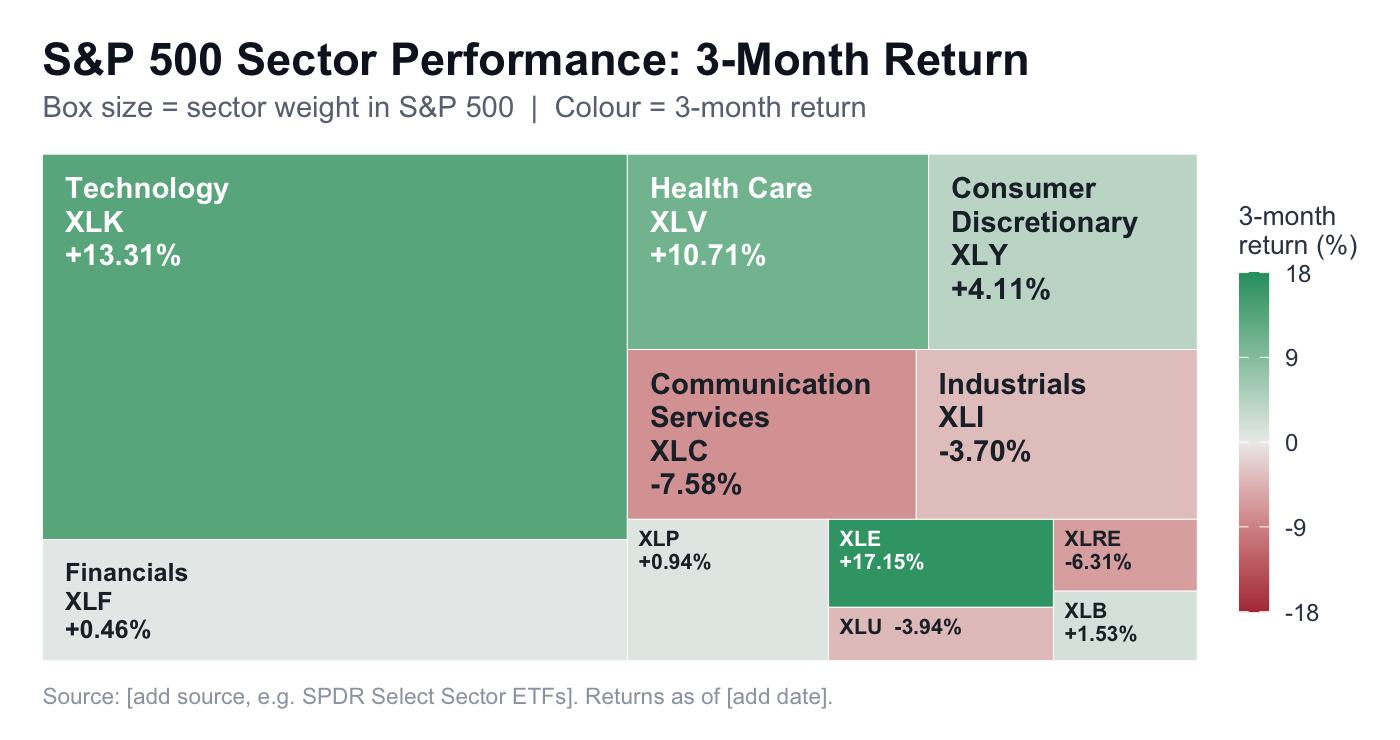
Rising Treasury yields have also contributed to a more risk-averse environment, making dividend-paying utility stocks less attractive relative to government bonds. Small-cap stocks have been particularly vulnerable, with the Russell 2000 retreating from its August record high and underperforming the S&P 500 Utilities sector, which has also faced pressure.
Graph 3: S&P 500 Sectors – 3 Month Snapshot
Source: State Street SPDR
Despite the recent volatility, the S&P 500 remained near record highs at $7,819. U.S. equity trading volume fell to its lowest level of the year, while investor optimism around corporate earnings and companies' ability to absorb elevated energy costs and interest rates helped sustain the market rally. Strong third-quarter corporate earnings, particularly from SpaceX, also supported sentiment. Meanwhile, Anthropic's IPO filing will provide another test of investor appetite for AI-related equities following the sector's recent pullback.
Real-World Assets (RWA) Outlook
---
Real Estate Environment
The U.S. housing market is experiencing its slowest pace in at least 25 years. Nearly one in five home sellers reduced their asking prices in September, while available housing inventory rose to its highest level since March 2020. Pending home sales also declined 4% month-over-month, reflecting continued weakness in housing demand. Homebuilder confidence deteriorated further, with the builder confidence index falling to 31, its lowest level in 14 years. Rising inventory and more frequent price reductions are strengthening buyers' negotiating power.
However, persistent affordability challenges continue to constrain demand. The Mortgage Bankers Association's (MBA) purchase application index fell 4% week-over-week, marking its sixth consecutive weekly decline and longest such streak, as elevated mortgage rates continue to weigh on prospective buyers.
Commodities overview
Gasoline prices recorded their largest monthly increase since the U.S./Israel–Iran war began. Iran-backed Houthi militants intensified attacks on Saudi Arabia, raising fears of a wider regional conflict and renewed tensions between the U.S. and Iran. These developments heightened concerns about potential disruptions to oil supplies and shipping through the Strait of Hormuz.
Brent crude rose to $116.72 per barrel, gaining more than 6% over a week, while West Texas Intermediate (WTI) increased to $103.27 per barrel. However, supply flows showed signs of recovery, with Persian Gulf oil flows reportedly returning to ~80% of pre-conflict levels.
Meanwhile, U.S. lawmakers introduced legislation to block Trump's proposed agreement with Moscow to release hundreds of millions of barrels of diesel, citing concerns that the arrangement could provide financial benefits to Russia.
Gold declined 20% from its peak, falling below $3,990 per ounce during the month to its lowest level since mid-July. Increasing expectations of a December interest-rate hike weighed on the non-yielding asset, as higher interest rates and borrowing costs make gold less attractive relative to yield-bearing investments. Investors have adopted a more cautious approach as they assess interest-rate expectations and broader market conditions. The technology-sector selloff, driven by concerns over AI valuations, also contributed to gold's decline.
Graph 4: Monthly Return on Gold
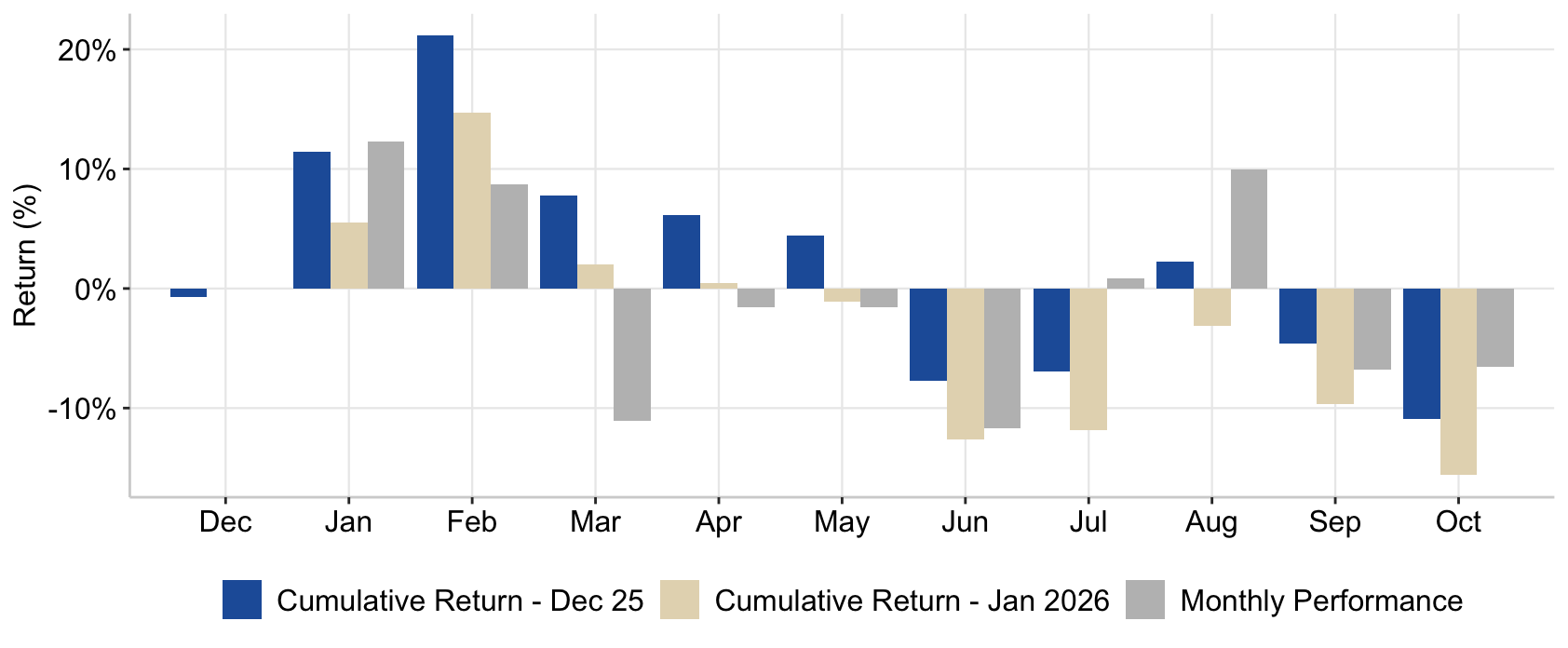
Note: The graph above showcases monthly gold returns since the start of the year with three scenarios. The first is standalone gold monthly returns followed by cumulative returns with starting points in December 17, 2025 and January 13, 2026, the dates that pmUSD was minted. The divergence between the two cumulative-return series demonstrates that pmUSD's timing of minting is important given its exposure to gold prices that will affect the collateral health.
Despite falling prices, gold ETFs tracked by Bloomberg recorded inflows for 14 consecutive weeks. Longer-term investors appear to be accumulating gold as a hedge against fiscal instability, geopolitical risks and currency debasement. Gold also recovered as Chinese buyers returned following a weeklong holiday and resumed market activity. Lower Treasury yields provided additional support, with bullion reaching a high of $4,218 per ounce during the month.
Silver declined more than 16% in October, falling to $52.55 per ounce and erasing gains from its rally that began in December, when prices subsequently climbed above $120 per ounce. The gold-to-silver ratio rose to its highest level since December, indicating that silver had weakened considerably relative to gold. The divergence suggests investors are more willing to maintain gold exposure amid interest-rate uncertainty, while silver has faced greater selling pressure.
Decentralized Finance (DeFi) Outlook
---
Cryptocurrencies
Bitcoin (BTC) gained 43% in Q3, marking its strongest quarterly performance since Q4 2024. During October, Bitcoin reached a high of $87,206, supported by renewed risk appetite. However, since late August, Bitcoin has struggled to regain momentum and fell below $80,000 as investors focused on upcoming Big Tech earnings, the Federal Reserve's policy decision and the Binance hack. The Senate's failure to advance the CLARITY Act was another setback for the industry, while institutional demand showed signs of weakening. Strategy Inc. paused its Bitcoin purchases for the first time in five weeks, removing a key source of buying demand.
Bitcoin ETFs recorded $772.4 million in net outflows between October 22 and 23, reversing more than $1 billion in inflows earlier in the week. However, spot Bitcoin ETFs attracted $526.6 million in net inflows on October 19, their largest single-day total since September 22. Over the preceding month, approximately $2.3 billion flowed into spot Bitcoin ETFs, with BlackRock's IBIT receiving the majority of those inflows.
BlackRock also applied to launch the iShares Bitcoin Managed Protect ETF (PBIT), a proposed buffer ETF designed to limit downside risk while retaining partial exposure to Bitcoin's gains. The fund would use an options-based strategy to absorb a portion of potential losses over a defined outcome period, while capping maximum potential gains.
Graph 5: BTC ETF Flows
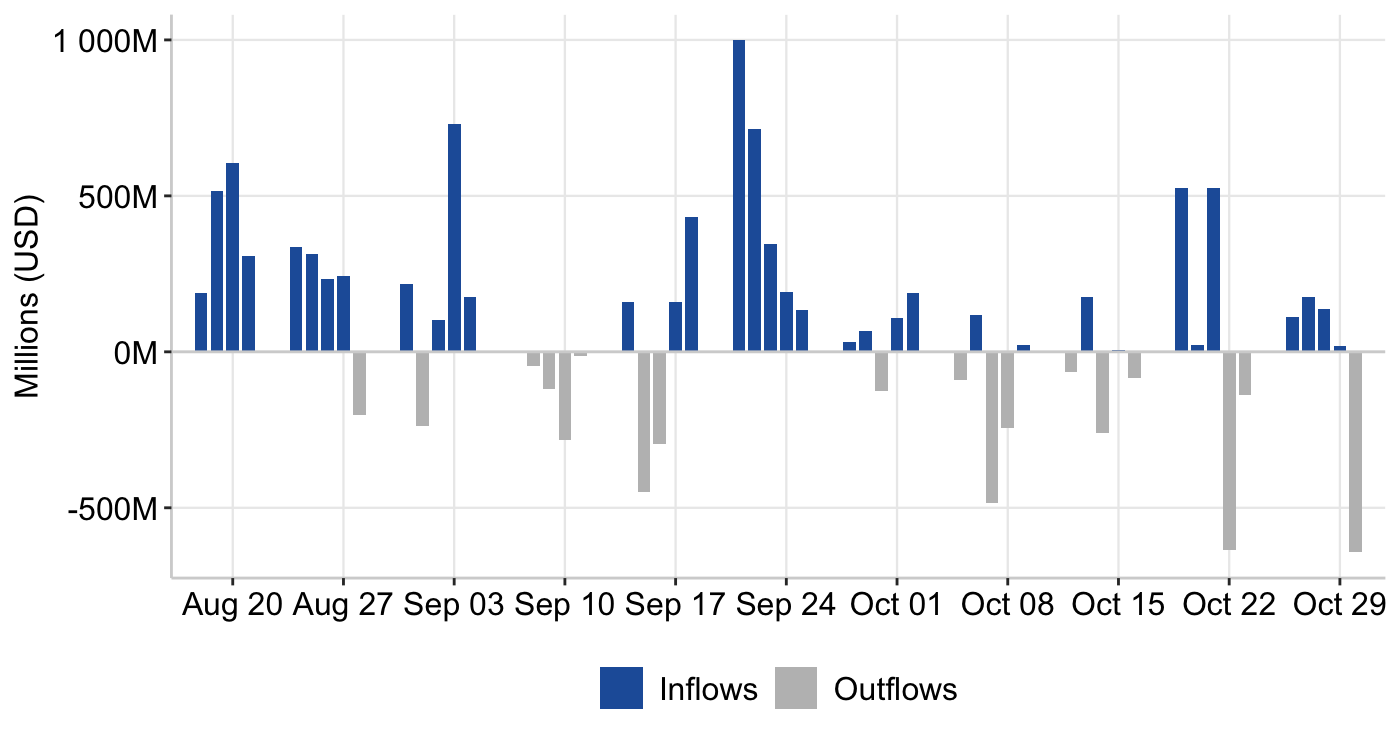
Cybersecurity remains a major concern for the cryptocurrency industry. The reported Binance-related incident involved ~$6.3 billion in stolen digital assets, making it the largest publicly known crypto heist. Approximately $3 billion of the stolen assets were frozen across blockchain networks, including more than $1.5 billion in USDT frozen by Tether and $800 million in USDC frozen by Circle. The incident follows attacks targeting Japanese GMO Internet Group's currency-trading platform and a reported $388 million Bitget hack, further highlighting vulnerabilities across crypto infrastructure. Following the Binance hack, Bitcoin fell below $77,000 for the first time in more than a month, contributing to broader market weakness.
Ethereum funds also experienced weakening investor demand. Spot Ethereum ETFs recorded $103.28 million in net outflows on October 19 and experienced outflows on all but two days over the past month. ETH ETFs have given back ~62% of the net inflows accumulated by their September peak, with BlackRock's ETH ETF accounting for 93% of total outflows. ETH declined 24% year-to-date, trading around $2,250.
While conventional crypto trading volumes and ETF flows have weakened, tokenized securities and on-chain equity derivatives are gaining traction. Tokenized stocks and ETFs generated more than $37 billion in on-chain trading volume in Q3 2026, with monthly volume increasing nearly 18-fold since January.
The SEC granted a five-year exemption allowing qualifying venues to trade tokenized U.S. stocks on-chain, supporting the expansion of blockchain-based securities markets. Meanwhile, perpetual futures linked to stocks, ETFs and equity indexes generated $201 billion in Q3 trading volume on Hyperliquid's blockchain.
Growing institutional participation and stablecoin adoption are supporting confidence in the broader crypto environment, as market activity increasingly expands beyond conventional cryptocurrency trading into tokenized financial assets and on-chain derivatives.
Stablecoins
Stablecoins are cryptocurrencies designed to maintain a relatively stable value, making them useful for preserving capital while remaining active on-chain. RAAC issues its own stablecoin, Precious-Metal USD (pmUSD), which operates on the Ethereum blockchain.
The total stablecoin market capitalization has reached $296.65 billion, but is currently slowing following several years of rapid growth. However, analysts believe stablecoin circulation could grow to $1.45 trillion by 2035. US dollar-pegged stablecoins Tether (USDT) and USD Coin (USDC) remain dominant, accounting for 84% of the market, as stablecoins backed by short-term US Treasuries continue to serve as the global standard.
Outside the US dollar, euro- and pound-denominated stablecoins remain a small share of the overall market. Circle’s regulated euro-denominated stablecoin, EURC, has a market capitalization of $492.6 million, while the tokenized British pound, tGBP, has a market capitalization of $26.6 million.
The Ethereum network hosts approximately $141.12 billion in stablecoin supply, representing roughly 48% of the global market, and continues to serve as the leading blockchain for stablecoin issuance and activity. The table below compares the market capitalizations of major stablecoins alongside the currencies currently paired with pmUSD.
Table 3: 1 Month Market Capitalization
| Stablecoin | Position | Market Capitalization | 30 Day % Change |
|---|---|---|---|
 pmUSD |
63 | $50.81M | +17.57% |
 USDT |
1 | $179.967B | -2.08% |
 USDC |
2 | $71.899B | -3.02% |
 PYUSD |
8 | $2.831B | 3.38% |
 crvUSD |
31 | $224.91M | -13.52% |
 frxUSD |
48 | $92.1M | -6.35% |
| Source: DefiLlama |
On October 21, the US Office of the Comptroller of the Currency issued a final rule implementing the GENIUS Act, setting requirements for payment stablecoin issuers and related custody activities under its jurisdiction, effective January 18, 2027. It gives issuers more flexibility on reserve holdings and drops the automatic seven-day redemption extension. Issuers must redeem within two business days, and large redemptions require OCC notification and an approved extension. Issuers remain prohibited from paying interest solely for holding a stablecoin. Still, the OCC dropped its proposed presumption against issuer arrangements with related third parties that pass yield to holders, moving to case-by-case review.
Stablecoins are also moving into payments and are emerging as a major growth opportunity for companies. Stablecoins can enable faster and cheaper cross-border payments, creating opportunities across commerce, corporate treasury and financial services. October saw large TradFi institutions bringing stablecoin rails into mainstream payments.
Samsung is enabling USDC transfers in Samsung Wallet for eligible U.S. Galaxy users from late October. Solana and Sui are going to provide the underlying blockchain support, while Bastion will serve as the custodian through Coinbase Prime Vault, with Coinbase as sub-custodian. Citi has expanded its partnership with Coinbase, integrating Citi so institutional clients can accept stablecoin payments at checkout.
RAAC Outlook
RAAC has two live products: Precious-Metal USD (pmUSD) and the Index Real Estate Token ($iREET). The following section reviews the characteristics of these products and focuses on the liquidity pools through which they generate yield.
Precious-Metal USD (pmUSD)
Precious-Metal USD (pmUSD) is RAAC's stablecoin, backed by $121.98 million in tokenized in-situ gold provided by I-ON Corporation. The asset provides investors with on-chain exposure to gold-backed value while also offering opportunities to generate yield through decentralized finance (DeFi).
Graph 6: pmUSD Price and Buybacks
Source: coingecko and Ethersan
pmUSD remains below its $1.00 USD peg, but in October RAAC started a discretionary open market purchase of pmUSD, purchasing $101.8K USD worth during the month. RAAC continues to monitor the peg and remains committed to implementing its proposed redemption facility, which would provide holders with a pathway to redeem pmUSD for physical gold-related value through recognized partners.
The collateral backing pmUSD averaged $109 million over the past month with the supply of pmUSD holding at $94 million before being burned to $89 million on November 1st due to declining gold prices. This represents an average collateral-to-supply ratio of 1.16x, providing a measure of overcollateralization. RAAC continues to monitor collateral coverage and maintain the health of the underlying asset.
$iREET
The Index Real Estate Token ($iREET) is a tokenized real estate index that provides exposure to a diversified portfolio of properties through a single token. By depositing a REET NFT into the index, users receive $iREET tokens representing a proportional share of the index's net asset value (NAV).
The iREET vault currently holds 17 tokenized properties with a combined value of $5.937 million, supporting a circulating supply of 5.72 million iREET tokens. The NAV per iREET is $1.0375, compared with a current market price of $1.0680.
The underlying properties generate ~$42.7K in monthly rental income, providing an income-generating component to the real estate portfolio. This rental income flows back into the ecosystem, further supporting RAAC's broader lending infrastructure.
Glimpse into the Curve Wars
RAAC is built directly within Curve Finance and actively participates in the Curve Wars, the ongoing competition to control governance power within the protocol. By locking CRV tokens, participants receive vote-escrowed CRV (veCRV), which grants voting rights to determine which liquidity pools receive reward emissions, ultimately shaping yield levels and liquidity depth. Protocols such as Convex Finance and Stake DAO have accumulated significant veCRV positions and, through their own tokens, offer alternative pathways to access Curve governance power. RAAC leverages the Convex pathway, this strategy has enabled RAAC to build significant governance influence within Curve.
Moreover, RAAC’s Locked CVX governance position extends beyond its own ecosystem. RAAC's Locked CVX effectively controls ~2.8% of voting power on protocol f(x) ecosystem and as a result RAAC has been directing veFXN votes toward our ecosystem friends, pushing FXN emissions towards the reUSD / fxUSD pool for the past 6 epochs.
Liquidity pools
Graph 8: RAAC Curve Pools - Gauges
Source: curve.finance
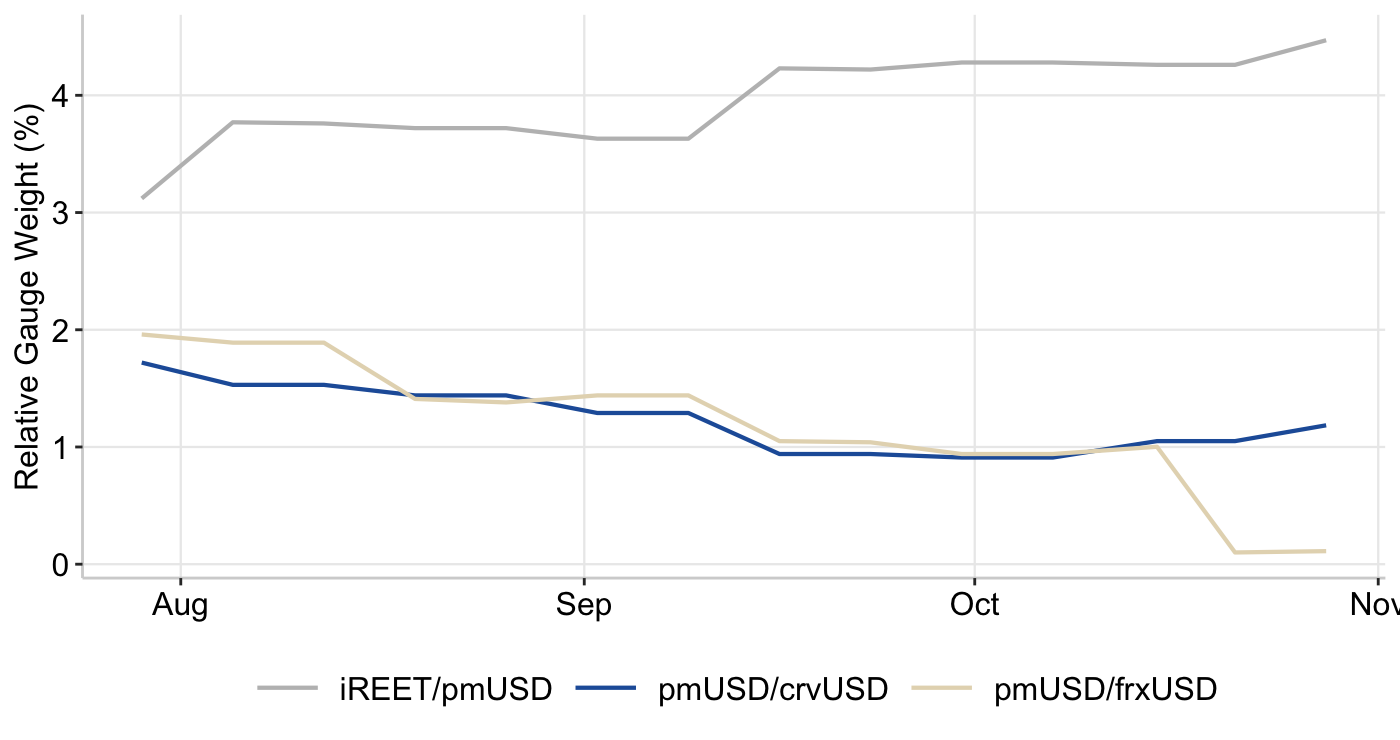
RAAC has 3 liquidity pools active on Curve Finance with pmUSD/crvUSD, pmUSD/frxUSD and iREET/pmUSD being actively incentivized. RAAC is built on the existing Curve Finance infrastructure, and Graph 8 illustrates the relative gauge weight of RAAC’s liquidity pools within the Curve Finance ecosystem.
While RAAC’s own voting power provides a base gauge weight, total veCRV gauge weighting reached 6.77% this epoch. Based on a CRV price of $0.3252, this equates to ~$81,919 in CRV emissions directed toward RAAC’s Curve pools, generating a 446% return on incentives and supporting competitive yields. The iREET pool received the largest share of emissions at 4.47%, equivalent to $54,094 at the current CRV price.
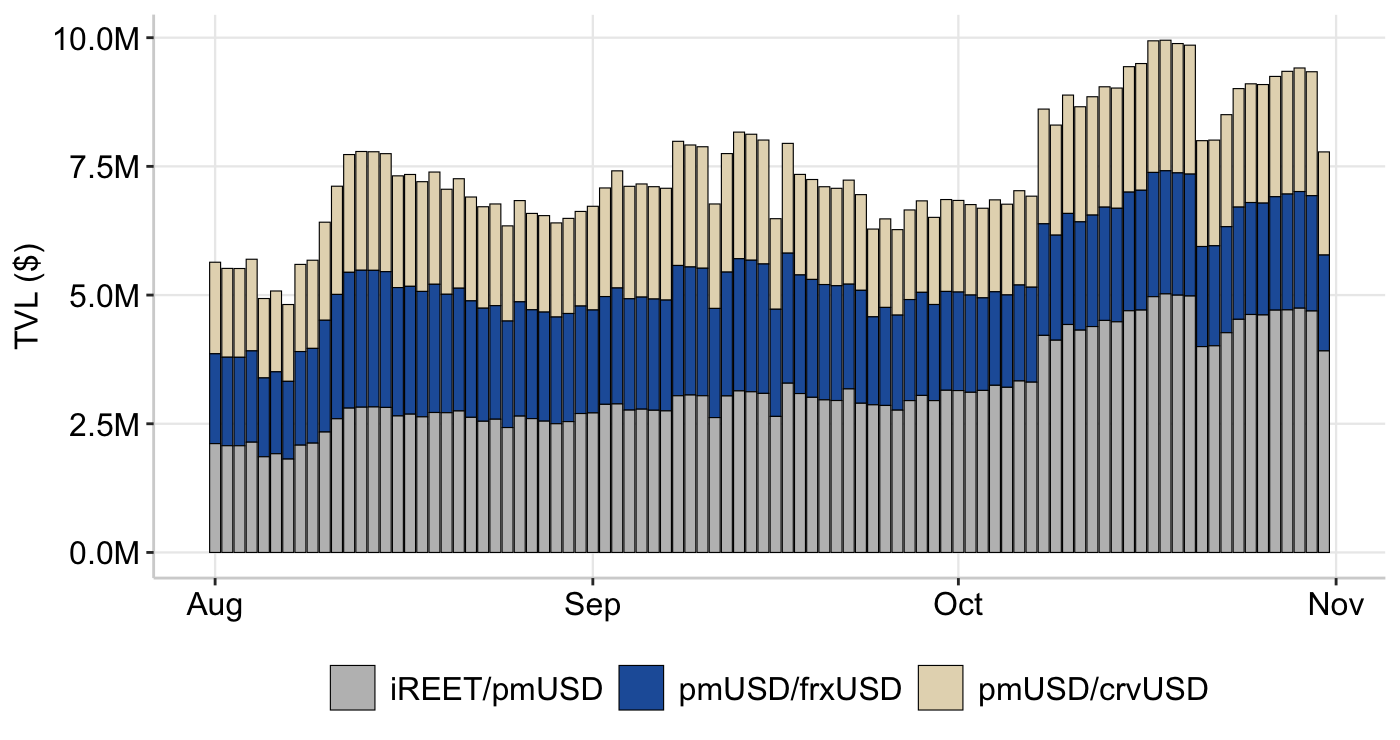
Graph 9: RAAC Curve Pools - Total Volume Locked (TVL)
Source: https://dune.com/4sh4/raac-pmusd
RAAC's Curve pools maintained an average combined Total Value Locked (TVL) of $7.17 million throughout October. The iREET/pmUSD pool held the largest share, averaging $2.94 million, followed by the pmUSD/crvUSD and pmUSD/frxUSD pools, which averaged $2.1 million and $2.0 million, respectively.
In addition to liquidity incentives, RAAC generates trading fees through its Curve pools. During October, approximately $658 in iREET fees was added back into the liquidity pools, further supporting liquidity depth and yield generation.
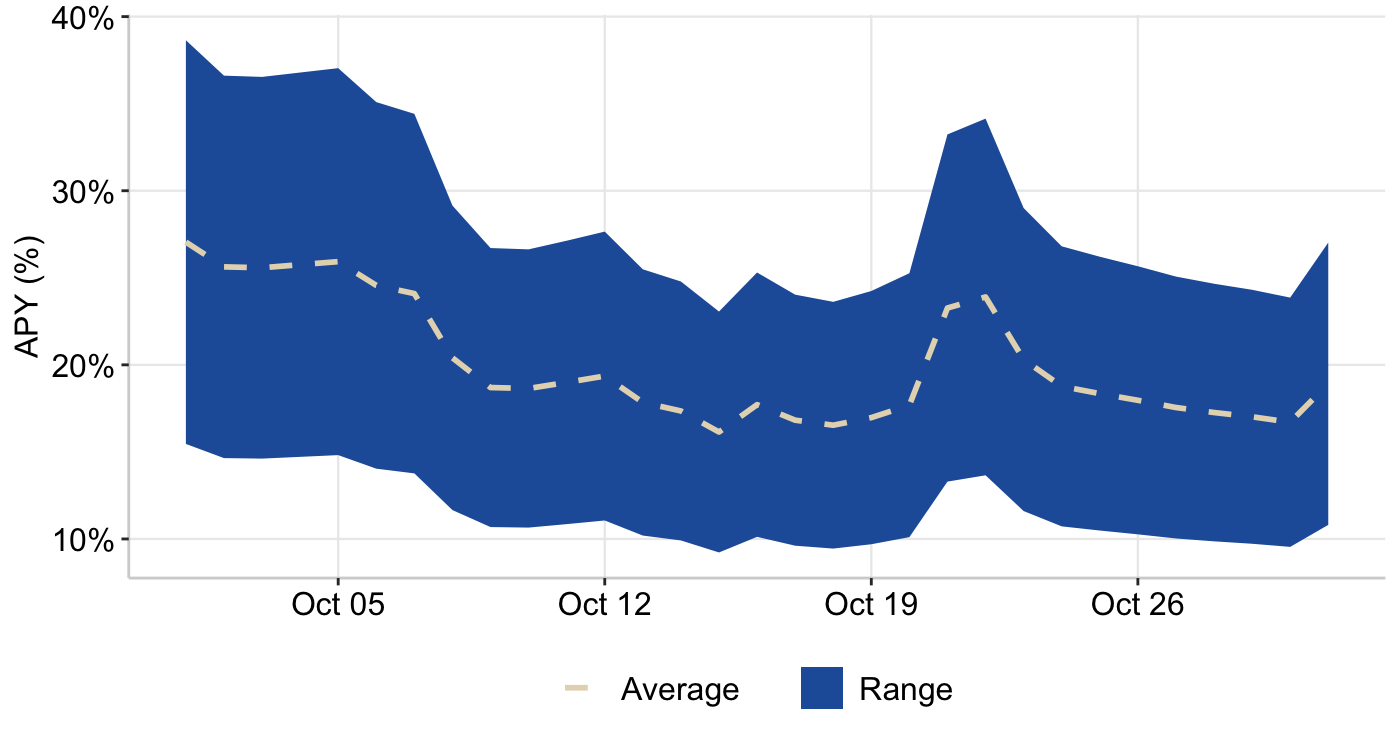
The weighted reward APY across RAAC’s Curve liquidity pools ranged from 9.22% to 38.64% over the past month. The iREET/pmUSD pool offered the highest returns after receiving the majority of RAAC’s voting incentives, with APYs ranging from 12.24% to 55.74% and an average yield of 27.217%. The pmUSD/crvUSD and pmUSD/frxUSD pools also remained competitive, with both reaching maximum APYs of 23%.
Figure 10: RAAC Curve Pools - Weighted Reward APY
 Source: curve.finance
Overall, yields across RAAC’s Curve pools remained competitive, with the iREET/pmUSD pool continuing to provide the highest yield opportunity. RAAC’s voting and incentive strategy continues to support liquidity and yield generation across its pools, including during periods of elevated market volatility.
Participants can further enhance their yields by depositing LP tokens into protocols such as Stake DAO, Convex Finance, Beefy Finance and Yearn Finance to access boosted rewards.
Resources
Data
https://tradingeconomics.com/indicators
https://fred.stlouisfed.org/series/DGS10
https://fred.stlouisfed.org/series/DGS5#
https://fred.stlouisfed.org/series/DGS30)
https://fred.stlouisfed.org/series/BAMLC0A0CM#
https://fred.stlouisfed.org/series/PRIME
https://fred.stlouisfed.org/series/MORTGAGE30US
https://app.koyfin.com/gyld
https://fred.stlouisfed.org/series/VIXCLS
https://defillama.com/stablecoins
https://www.coingecko.com
https://www.cboe.com/us/indices/dashboard/ovx-GVZ/
https://www.cboe.com/us/indices/dashboard/ovx/
https://www.convexfinance.com/
https://dune.com/4sh4/raac-pmusd
https://www.curve.finance/dao/ethereum/gauges
https://www.curve.finance/dex/ethereum/pools?search=pmusd
https://www.stakedao.org/yield?search=pmusd
https://curve.convexfinance.com/stake
https://app.beefy.com/
https://yearn.fi/vaults?type=lp&search=pmusd
https://app.morpho.org/ethereum/market/0x72cc79433e9f91c2a185422725510f4bdd19c9006010f464f851468b2371b756/srroyusdc-pmusd?tab=market#advanced
https://www.ssga.com/us/en/intermediary/resources/sector-tracker#fundTicker=spym¤tTab=monthThree
News
https://www.coindesk.com/tech/2026/10/08/solana-partners-with-samsung-to-integrate-usdc-in-82-million-phoneshttps://www.coindesk.com/tech/2026/10/08/solana-partners-with-samsung-to-integrate-usdc-in-82-million-phones
https://www.coindesk.com/policy/2026/10/21/occ-s-final-rule-to-start-fresh-in-weighing-stablecoin-rewards-against-genius-act-ban
https://www.coindesk.com/policy/2026/10/26/canada-opens-consultation-on-draft-stablecoin-rules-maintains-ban-on-yields
https://finance.yahoo.com/markets/crypto/articles/citi-just-connected-6-trillion-070858024.html
https://finance.yahoo.com/markets/currencies/articles/dollar-firms-ahead-central-bank-090655127.html
https://www.occ.gov/news-issuances/bulletins/2026/bulletin-2026-50.html
https://www.reuters.com/world/asia-pacific/view-analysts-react-boj-decision-keep-rates-steady-2026-10-30/
Quantitative Monthly Report
News:
https://www.bloomberg.com/news/articles/2026-10-01/treasury-10-year-yield-hits-highest-since-2002-on-rate-outlook-mup7ryq2
https://www.bloomberg.com/news/articles/2026-10-01/rising-yields-are-wreaking-havoc-on-stocks-outside-the-ai-trade
https://www.bloomberg.com/news/live-blog/2026-10-02/us-employment-report-for-september
https://www.bloomberg.com/news/articles/2026-10-02/bond-traders-pull-back-on-fed-hike-bets-after-soft-jobs-data
https://www.bloomberg.com/news/articles/2026-10-05/dollar-nears-strongest-level-this-year-as-cracks-emerge-in-rally
https://www.bloomberg.com/news/articles/2026-10-04/asian-stocks-to-rise-as-hike-bets-ease-oil-climbs-markets-wrap
https://www.bloomberg.com/news/articles/2026-10-01/ten-reasons-investors-are-driving-government-bond-yields-higher
https://www.bloomberg.com/news/articles/2026-10-05/s-p-500-closes-in-on-record-high-as-tech-rallies-markets-wrap-muvv94wz
https://www.bloomberg.com/news/articles/2026-10-02/robinhood-stock-tokens-fueled-a-440-million-memecoin-frenzy
https://www.bloomberg.com/news/articles/2026-10-06/bessent-axing-20-year-treasury-may-send-yields-higher-bnp-warns
https://www.bloomberg.com/news/articles/2026-10-06/us-yields-fall-from-2002-high-as-oil-dips-bessent-vows-on-debt
https://www.bloomberg.com/news/articles/2026-10-05/crypto-elite-gather-in-singapore-as-bitcoin-s-rally-buoys-bulls
https://www.bloomberg.com/news/articles/2026-10-07/fed-minutes-show-hawkish-unity-behind-september-rate-hike
https://www.bloomberg.com/news/articles/2026-10-07/us-mortgage-rates-jump-to-7-49-highest-in-nearly-three-years
https://www.bloomberg.com/news/articles/2026-10-07/stock-market-today-dow-s-p-live-updates?srnd=homepage-americas
https://www.bloomberg.com/news/articles/2026-10-07/gold-near-nine-week-low-on-prospects-for-rate-hike-by-year-end
https://www.bloomberg.com/news/articles/2026-10-05/gold-edges-higher-as-markets-weigh-jobs-data-impact-on-fed-path
https://www.bloomberg.com/news/articles/2026-10-06/gold-steady-as-more-oil-and-falling-yields-ease-rate-hike-bets
https://www.bloomberg.com/news/articles/2026-10-08/stock-market-today-dow-s-p-live-updates?srnd=phx-markets
https://www.bloomberg.com/news/articles/2026-10-09/gold-steadies-as-traders-assess-us-iran-tensions-fed-rate-path
https://www.bloomberg.com/news/articles/2026-10-08/us-mortgage-rates-rise-for-seventh-straight-week-climbing-to-7-4
https://www.bloomberg.com/news/articles/2026-10-08/stock-market-today-dow-s-p-live-updates
https://www.bloomberg.com/news/articles/2026-10-11/oil-rises-on-mideast-attacks-dollar-edges-higher-markets-wrap
https://www.bloomberg.com/news/articles/2026-10-13/korean-chip-stocks-sink-on-chinese-rival-worry-broadcom-remarks
https://www.bloomberg.com/news/articles/2026-10-12/stock-market-today-dow-s-p-live-updates
https://www.bloomberg.com/news/articles/2026-10-12/mortgage-shock-sends-us-pending-home-sales-to-near-12-year-low
https://www.bloomberg.com/news/articles/2026-10-13/s-p-500-futures-little-changed-as-banks-report-chipmakers-fall
https://www.bloomberg.com/news/articles/2026-10-13/stock-market-today-dow-s-p-live-updates
https://www.bloomberg.com/news/articles/2026-10-14/us-mortgage-rates-hit-7-5-extending-slump-in-purchase-activity
https://www.bloomberg.com/news/articles/2026-10-13/strategy-s-saylor-sees-bitcoin-moving-back-up-beyond-100-000
https://www.bloomberg.com/news/articles/2026-10-14/dollar-advances-to-highest-since-may-2025-on-fed-hike-views
https://www.bloomberg.com/news/articles/2026-10-14/us-consumer-prices-climb-by-most-since-april-on-fuel-costs
https://www.bloomberg.com/news/articles/2026-10-14/us-treasuries-slump-as-hot-inflation-lifts-fed-rate-hike-bets
https://www.bloomberg.com/news/articles/2026-10-14/stock-market-today-dow-s-p-live-updates
https://www.bloomberg.com/news/articles/2026-10-15/us-producer-prices-rise-by-most-in-more-than-four-years
https://www.bloomberg.com/news/articles/2026-10-15/us-retail-sales-rise-more-than-expected-on-gasoline-receipts
https://www.bloomberg.com/news/articles/2026-10-15/us-mortgage-rates-unchanged-at-7-4-as-housing-market-struggles
https://www.bloomberg.com/news/articles/2026-10-14/gold-holds-loss-as-hot-inflation-lifts-october-rate-hike-bets
https://finance.yahoo.com/markets/crypto/articles/bitcoin-etfs-pull-526-6-061819056.html
https://finance.yahoo.com/markets/crypto/articles/ether-etfs-given-back-62-143035053.html
https://finance.yahoo.com/markets/crypto/articles/bitcoin-etf-news-blackrock-wants-123143491.html
https://www.bloomberg.com/news/articles/2026-10-16/oil-tops-110-for-first-time-since-may-as-supply-risk-grows
https://www.bloomberg.com/news/articles/2026-10-17/coreweave-woes-risk-shutting-down-ai-junk-market-credit-weekly
https://www.bloomberg.com/news/articles/2026-10-18/stock-market-today-dow-s-p-live-updates
https://www.bloomberg.com/news/articles/2026-10-16/s-p-500-steady-as-warsh-boosts-expectations-of-rate-hold
https://www.bloomberg.com/news/articles/2026-10-19/us-homebuilder-sentiment-drops-to-14-year-low-on-depressed-sales
https://www.bloomberg.com/news/articles/2026-10-19/hassett-says-cpi-data-shows-inflation-needs-some-work
https://www.bloomberg.com/news/articles/2026-10-18/latest-oil-market-news-and-analysis-for-oct-19
https://www.bloomberg.com/news/articles/2026-10-19/stock-market-today-dow-s-p-live-updates
https://www.bloomberg.com/news/articles/2026-10-20/stock-market-today-dow-s-p-live-updates
https://www.bloomberg.com/news/articles/2026-10-21/french-bond-risk-gauge-nears-160-basis-points-hits-15-year-high
https://www.bloomberg.com/news/articles/2026-10-21/the-treasury-market-s-new-power-brokers-are-pickier-than-ever
https://www.bloomberg.com/news/articles/2026-10-19/bitcoin-rebounds-above-82-000-as-oil-s-retreat-lifts-risk-mood
https://www.bloomberg.com/news/articles/2026-10-21/stock-market-today-dow-s-p-live-updates
https://www.bloomberg.com/news/articles/2026-10-21/us-futures-climb-with-spacex-results-helping-boost-ai-sentiment
https://www.bloomberg.com/news/articles/2026-10-23/treasuries-link-to-ai-shows-sharp-shift-as-haven-trade-returns
https://www.bloomberg.com/news/articles/2026-10-22/us-mortgage-rates-decline-for-first-time-in-nine-weeks-to-7-32
https://www.bloomberg.com/news/articles/2026-10-21/gold-edges-lower-as-traders-weigh-mideast-signals-fed-rate-path
https://www.bloomberg.com/news/articles/2026-10-22/stock-market-today-dow-s-p-live-updates
https://www.bloomberg.com/news/articles/2026-10-22/latest-oil-market-news-and-analysis-for-oct-23
https://www.bloomberg.com/news/articles/2026-10-25/us-equity-futures-climb-as-crude-oil-price-dips-markets-wrap
https://www.bloomberg.com/news/articles/2026-10-26/japan-s-katayama-vows-to-address-cyber-attack-on-fx-with-urgency
https://www.bloomberg.com/news/articles/2026-10-26/stock-market-today-dow-s-p-live-updates
https://www.bloomberg.com/news/articles/2026-10-27/stock-market-today-dow-s-p-live-updates
https://www.bloomberg.com/news/articles/2026-10-26/bitcoin-dips-below-80-000-as-ai-related-market-selloff-deepens
https://www.bloomberg.com/news/articles/2026-10-22/tokenized-stocks-etf-onchain-trading-surged-to-37-billion-last-quarter-dune
https://www.bloomberg.com/news/articles/2026-10-27/fed-seen-holding-rates-with-nod-to-december-decision-day-guide
https://www.bloomberg.com/news/articles/2026-10-28/alphabet-reports-disappointing-revenue-income-shares-drop
https://www.bloomberg.com/news/articles/2026-10-28/weaker-euro-boosts-european-exporters-as-earnings-season-peaks
https://www.bloomberg.com/news/articles/2026-10-28/global-bond-sales-shatter-record-fueled-by-ai-borrowing-binge
https://www.bloomberg.com/news/articles/2026-10-28/stock-market-today-dow-s-p-live-updates
https://www.bloomberg.com/news/articles/2026-10-29/us-economy-grows-a-faster-than-expected-3-4-most-in-a-year
https://www.bloomberg.com/news/articles/2026-10-29/binance-founder-says-possible-hack-of-exchange-bitcoin-falls
https://www.bloomberg.com/news/articles/2026-10-30/boj-holds-benchmark-rate-steady-as-expected-after-september-hike
https://www.bloomberg.com/news/articles/2026-10-29/gold-steadies-near-4-000-as-inflation-keeps-rate-hike-bets-firm
https://www.bloomberg.com/news/articles/2026-10-30/record-binance-hack-shows-no-crypto-firm-is-too-big-to-breach
https://www.bloomberg.com/news/articles/2026-10-29/us-mortgage-rates-decline-for-second-straight-week-to-7-24