

RAAC’s August Mid-Month Yield Report
Real Asset Acquisition Corp. (RAAC) continues to deploy an effective voting strategy, enabling its Curve pools to offer competitive yields.
- Weighted reward APYs across all Curve pools ranged from 8.38% to 44.47%
- The iREET/pmUSD pool delivered the highest yields, ranging from 13.5% to 64.8%
- RAAC achieved a 232.77% return on incentives during the latest epoch
RAAC Products
RAAC has two live products: Precious-Metal USD (pmUSD) and the Index Real Estate Token ($iREET). pmUSD is backed by gold through tokenized in-situ precious metal reserves provided by I-ON Corporation, valued at $121.98 million. $iREET is a tokenized real estate index that brings traditionally illiquid real estate assets on-chain, allowing them to be used to generate yield and as collateral for borrowing. Currently, $iREET consists of 17 properties with a total value locked (TVL) of $5.9 million.
RAAC’s Liquidity pools
RAAC has four liquidity pools on Curve Finance. Figure 1 provides a snapshot of the current yields and TVL across RAAC’s Curve pools. Figure 2 showcases alternative protocols where participants can further enhance their yields by depositing their LP tokens to access boosted rewards.
Figure 1: Curve Pools - August 17, 2026
| Pool | Base vAPY | Rewards tAPR CRV + Incentives | TVL |
|---|---|---|---|
  pmUSD/crvUSD pmUSD/crvUSD |
0.03% | 7.94% → 19.84% CRV | $2.13M |
  pmUSD/frxUSD pmUSD/frxUSD |
0.08% | 8.32% → 20.79% CRV | $2.44M |
  iREET/pmUSD iREET/pmUSD |
0.00% | 15.69% → 39.24% CRV | $2.64M |
  pmUSD/OUSD pmUSD/OUSD |
0.03% | 12.72% → 31.79% CRV | $9.68K |
Source: curve.finance
Note: RAAC is not actively directing incentives to the pmUSD/OUSD pool at this time.
Figure 2: Boosted Yield Opportunities - August 17, 2026
| Protocols | ||||
|---|---|---|---|---|
 Convex Convex |
 Stake DAO Stake DAO |
 Beefy Beefy |
 Yearn Yearn |
|
  pmUSD/crvUSD pmUSD/crvUSD |
19.54% | 12.18% | 11.67% | -- |
  pmUSD/frxUSD pmUSD/frxUSD |
17.39% | 16.00% | 15.62% | 20.60% |
  pmUSD/OUSD pmUSD/OUSD |
16.95% | 16.82% | 16.46% | -- |
  iREET/pmUSD iREET/pmUSD |
33.50% | 25.01% | 25.47% | -- |
Source: Convex Finance, Stake DAO, Beefy Finance, Yearn Finance
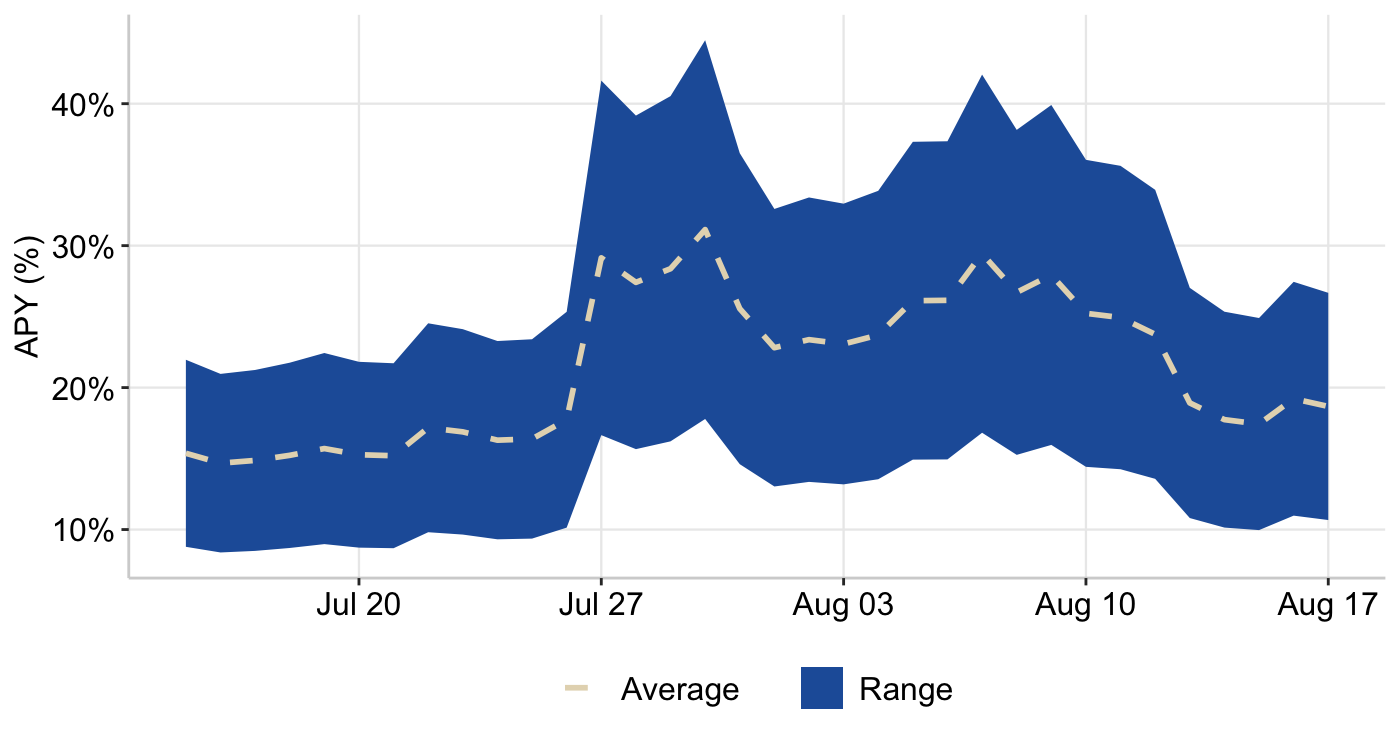
The pools offer competitive and sustainable yields due to RAAC having sufficient voting power to direct emissions and incentives toward its pools. The weighted reward APY across RAAC’s Curve liquidity pools ranged from 8.38% to 44.47% over the past month, with an average of 21.40%.
Figure 3: RAAC Curve Pools - Weighted Reward APY
Source: Curve.Finance
The iREET/pmUSD pool continues to offer the highest yields, ranging from 13.50% to 64.85%, with an average APY of 30.10%, as RAAC has heavily incentivized the pool. Changes in TVL have had a minimal effect on yields, as TVL has remained relatively stagnant and averaged ~$11 million across all pools over the past month.
Curve Gauges
RAAC is built directly within Curve Finance and actively participates in the Curve Wars, the ongoing competition to control governance power within the protocol. By locking CRV tokens, participants receive vote-escrowed CRV (veCRV), which grants voting rights to determine which liquidity pools receive reward emissions, ultimately shaping yield levels and liquidity depth. Protocols such as Convex Finance and Stake DAO have accumulated significant veCRV positions and, through their own tokens, offer alternative pathways to access Curve governance power.
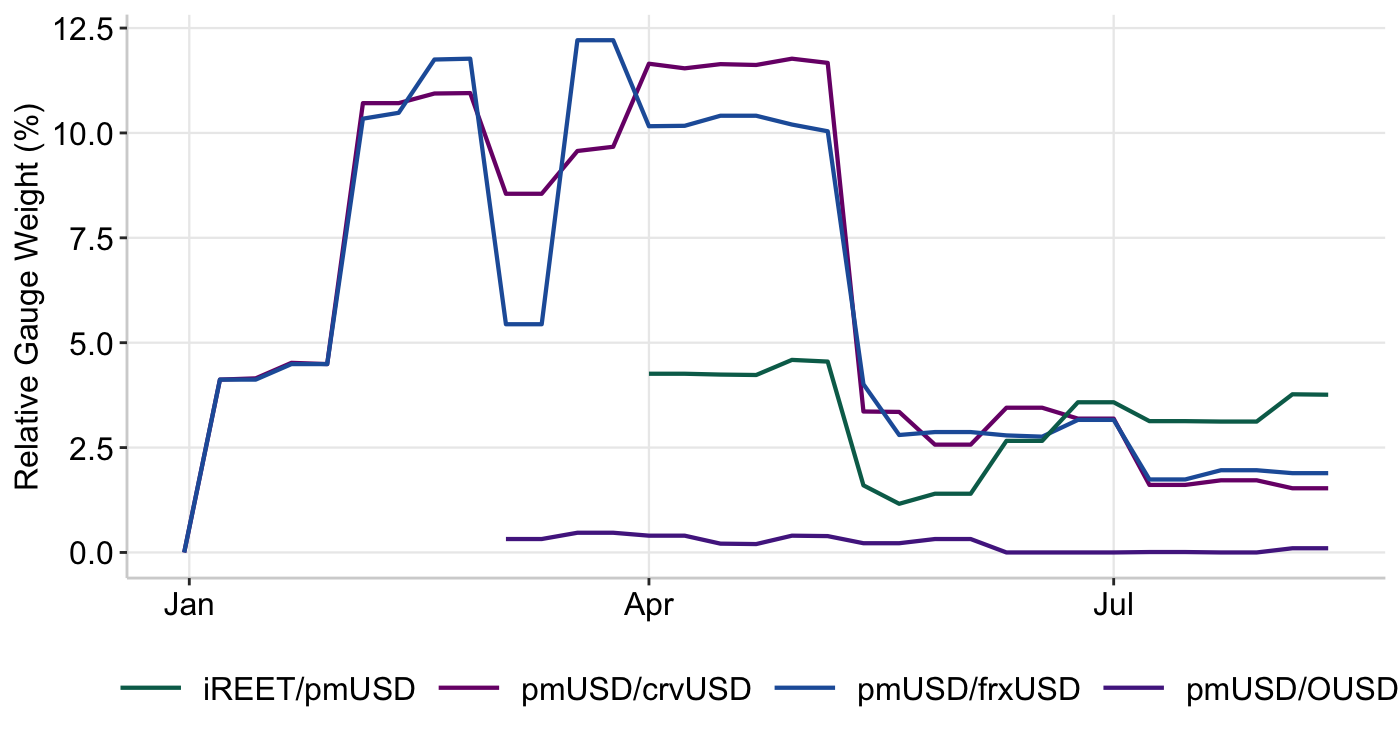
To date, RAAC has leveraged the Convex strategy (see Appendix), which has enabled RAAC to control making it the fourth-largest governance participant with a voting power of 4.49%. This positioning allows RAAC to consistently direct emissions toward its own liquidity pools, creating a structural advantage that supports RAAC's position as a leading real-world asset DeFi platform offering sustainable yield opportunities.
Figure 5: RAAC Curve Gauges
Source: Curve.Finance
Curve’s annual emission reduction went into effect on August 12, with emissions falling from 1115.5M CRV per year to 97.2M CRV per year. This represents a 15.9% reduction in the amount of new CRV entering circulation annually, which is intended to reduce CRV inflation and increase token scarcity over time.
As a result, all Curve gauges will proportionally receive fewer emissions, while the relative share of voting power remains unchanged. RAAC therefore retains its 4.49% share of Curve voting power, but that voting power now controls a smaller pool of newly emitted CRV. This makes existing governance power more valuable, as there is a smaller pool of newly issued CRV available for distribution.
While RAAC’s own voting power provides a base gauge weight, total veCRV gauge weighting reached 7.22% this epoch. This equates to $66,553.16 in CRV emissions directed toward RAAC’s Curve pools during the latest epoch, representing a 232.77% return on incentives. The iREET/pmUSD pool continues to receive the largest emission allocation among RAAC’s pools, with 166,652.02 CRV tokens directed toward the pool.
Appendix
The Kingmaker Ratio is a RAAC-specific metric used to evaluate whether acquiring veCRV directly or accumulating voting power through another protocol is the most efficient strategy per dollar. The metric is defined as:
Kingmaker Ratio = veCRV/$ via protocol iveCRV/$ via CRV
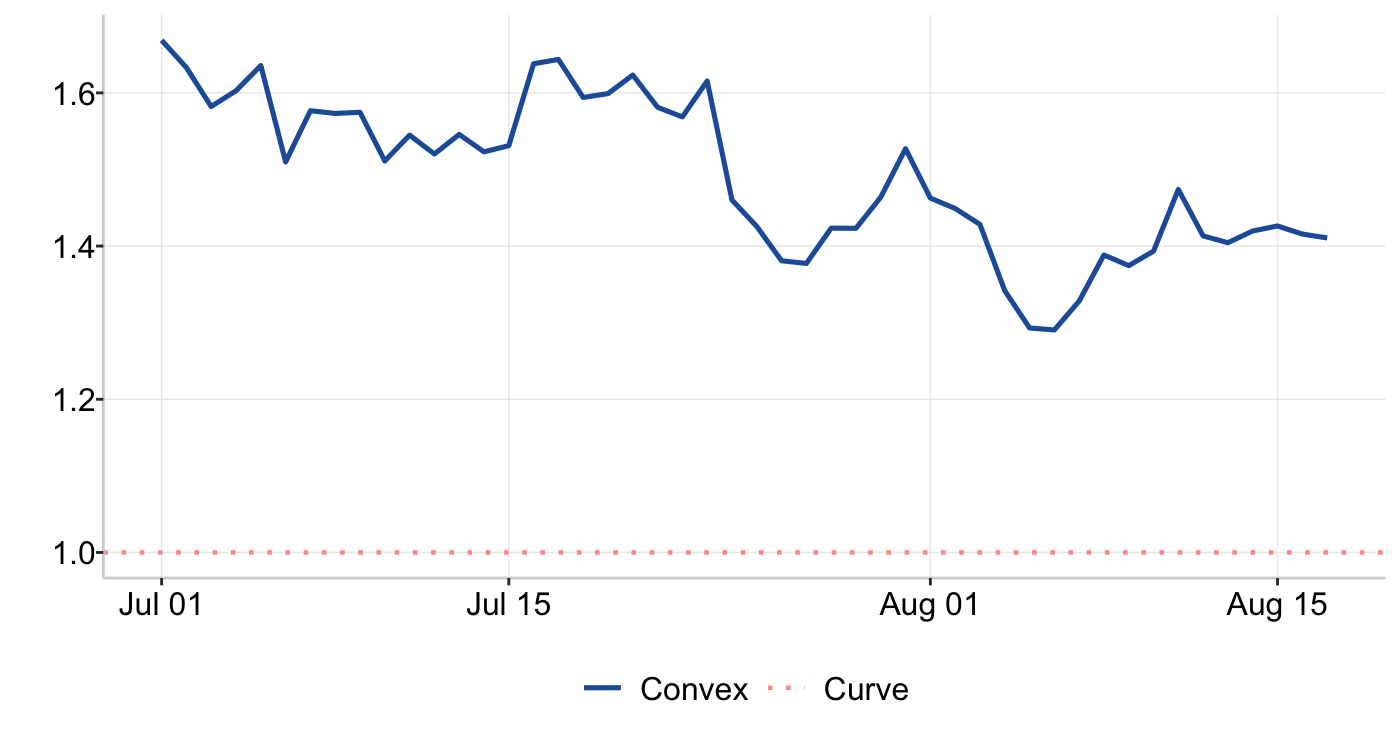
Using the above equation, the ratio is calculated for Convex (vlCVX). While Stake DAO is another viable route, it is better suited to individual users rather than the protocol itself. Graph 6 tracks the evolution of this ratio over the past month, highlighting changes in relative efficiency. A ratio greater than 1.0 indicates that Convex is the more capital-efficient route, providing greater voting power per $1 spent compared with directly acquiring veCRV. This strategy has enabled RAAC to build significant governance influence.
Graph 6: Kingmaker Ratio
Source: buycvxcorrect.netlify.app
Looking specifically at price changes since the beginning of August, the start of the recent price appreciation saw the Kingmaker Ratio at 1.46 before briefly dipping to 1.29 and then recovering to 1.40. The ratio initially declined as Convex began its price appreciation, making direct CRV acquisition marginally more efficient. However, the ratio subsequently recovered as Convex’s price gains gained momentum and the relative efficiency between the two strategies stabilized.
Despite this temporary decline, the ratio remained above 1.0 throughout the period, indicating that Convex remained the more capital-efficient option for acquiring voting power, even as its relative efficiency narrowed.