

Overview
Macroeconomic & Traditional Finance Outlook
The Fed held rates in July with no forward guidance, with markets pricing in a potential hike for September. GDP growth came in below expectations for Q2; inflation is easing, while the labour market still holds strong. AI is driving the economy but investors are becoming more selective on companies that produce tangible results. Treasury rates and mortgages remain elevated with hitting highs not seen since 2007, as investors demand higher compensation for holding government debt. The Japanese Yen briefly weakened but surged amid federal bank intervention.
Real-World Assets (RWA) Outlook
Housing continues to be pressured by high mortgage rates as demand suppresses supply. Oil was volatile this month posting its largest one day decline due to changing headlines from the middle east conflict. Gold remains under pressure, approximately 20% below levels at the start of the Iran war as investors continue to favor high interest rates and a strong dollar over gold's safe-haven appeal.
Decentralized Finance (DeFi) Outlook
Bitcoin remains range bound but ETF inflows have now turned positive. The Clarity Act remains in deliberation and needs support from democrats to be passed. Stablecoins continue to be integrated into traditional finance with players such as Visa, Morgan Stanley, and Robinhood participating within the space.
RAAC Outlook
Throughout July, RAAC continued to work on delivering the redemption facility. pmUSD, while currently depegged, remains well-collateralized. Meanwhile, RAAC directs voting power toward the $iREET/pmUSD liquidity pools on Curve to sustain its high APY.
Macroeconomic & Traditional Finance Outlook
United States
The Federal Open Market Committee (FOMC) voted 9-3 to keep interest rates unchanged at 3.50%–3.75%, with three Fed officials favouring an immediate rate hike. Federal Reserve Chair Kevin Warsh stated that financial conditions had already tightened since June and that the Fed would take a wait-and-see approach, as the economy continues to grow at a solid pace. Warsh also reiterated that there is no "soft" inflation target, emphasizing the Fed's commitment to returning inflation to its 2% target. He has also moved away from providing forward guidance to give the Fed greater flexibility in responding to changing economic conditions. However, markets continue to seek greater policy certainty, and this disconnect has contributed to increased volatility. Markets are now pricing in a 50% probability of a rate hike in September.
The U.S. economy grew at an annualized rate of 1.5% in Q2, below expectations, although underlying growth remained stronger than the headline figure suggests, with AI investment continuing to emerge as a key economic driver. Consumer spending, which accounts for roughly two-thirds of U.S. GDP, exceeded expectations, rising 3.2%. Inflation also showed signs of easing in June, with consumer prices falling 0.4% month-over-month and core CPI remaining unchanged. The Fed's preferred inflation measure, PCE, declined from 4.1% to 3.7%, supported in part by lower gasoline prices and temporarily stable energy markets. Meanwhile, the labour market remained resilient, with unemployment falling to 4.2% and initial jobless claims declining to 187,000, their lowest level since 1969. While a strong labour market continues to support economic activity, it also gives the Federal Reserve greater flexibility to keep interest rates higher for longer as it remains focused on bringing inflation back to target.
Table 1: US Indicators
| Indicator | Period | Actual | Previous | Consensus |
|---|---|---|---|---|
| GDP | Q2 | 1.5% | 2.1% | 2.1% |
| Unemployment | June | 4.2% | 4.3% | 4.3% |
| Core CPI (YoY) | June | 2.6% | 2.9% | 2.8% |
| 1YR Inflation Expectations | July | 4.2% | 4.6% |
Source: tradingeconomics
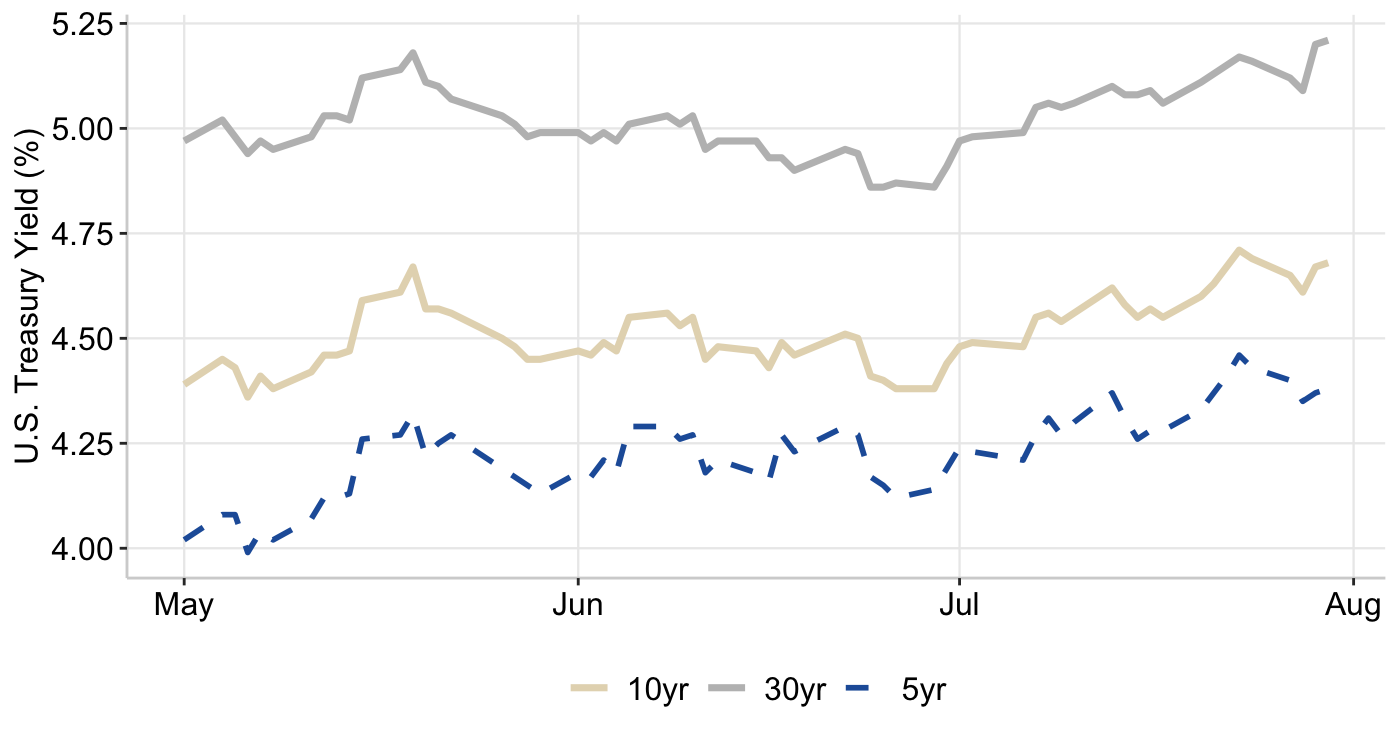
Treasury yields remained elevated this month as persistent geopolitical risks and higher oil prices kept inflationary pressures elevated, reinforcing expectations that interest rates will remain higher for longer. This environment continued to weigh on existing bonds, as investors sold older, lower-yielding debt in anticipation of higher rates, pushing bond prices lower.
The 10-year Treasury yield rose to 4.70%, its highest level of 2026. Following the FOMC meeting, investors continued selling long-term Treasuries, driving the 30-year Treasury yield to 5.23%, its highest level since 2007. Markets had expected Kevin Warsh to take a more decisive stance after weeks of hawkish commentary. Instead, the bond market effectively tightened financial conditions on its own, as investors demanded higher yields to hold long-term government debt. Despite the rise in long-term yields, the yield curve steepened as 2-year yields declined, suggesting markets do not expect the Federal Reserve to raise interest rates in the near term.
Graph 1: U.S. 5-Year, 10-Year, & 30-Year Treasury Yields
Source: FRED
Yields tend to rise and fall with expectations for economic growth, inflation, and the U.S. government’s borrowing needs. However, over the past year, there has been persistent upward pressure as investors demand higher returns for holding government debt. This reflects growing concerns over the U.S. government’s large and ongoing fiscal deficits, which are making borrowing expensive across the economy. At the same time, AI companies are competing with the U.S. government for the same pool of investor capital, adding further pressure to yields. As a result, experts believe long-term Treasury yields could continue to rise, potentially reaching 5.5% over the next 12 months.
Credit spreads remained elevated this month, ranging between 0.75 and 0.81, as investors demanded greater compensation for risk. Large technology companies continue to spend hundreds of billions of dollars on AI infrastructure, locking up significant amounts of capital for decades. The key concern is whether these investments will generate sufficient long-term returns to justify the spending. As a result, investment-grade technology bond spreads widened from 0.76% to 0.89%, with recent bond issuances seeing weaker investor demand.
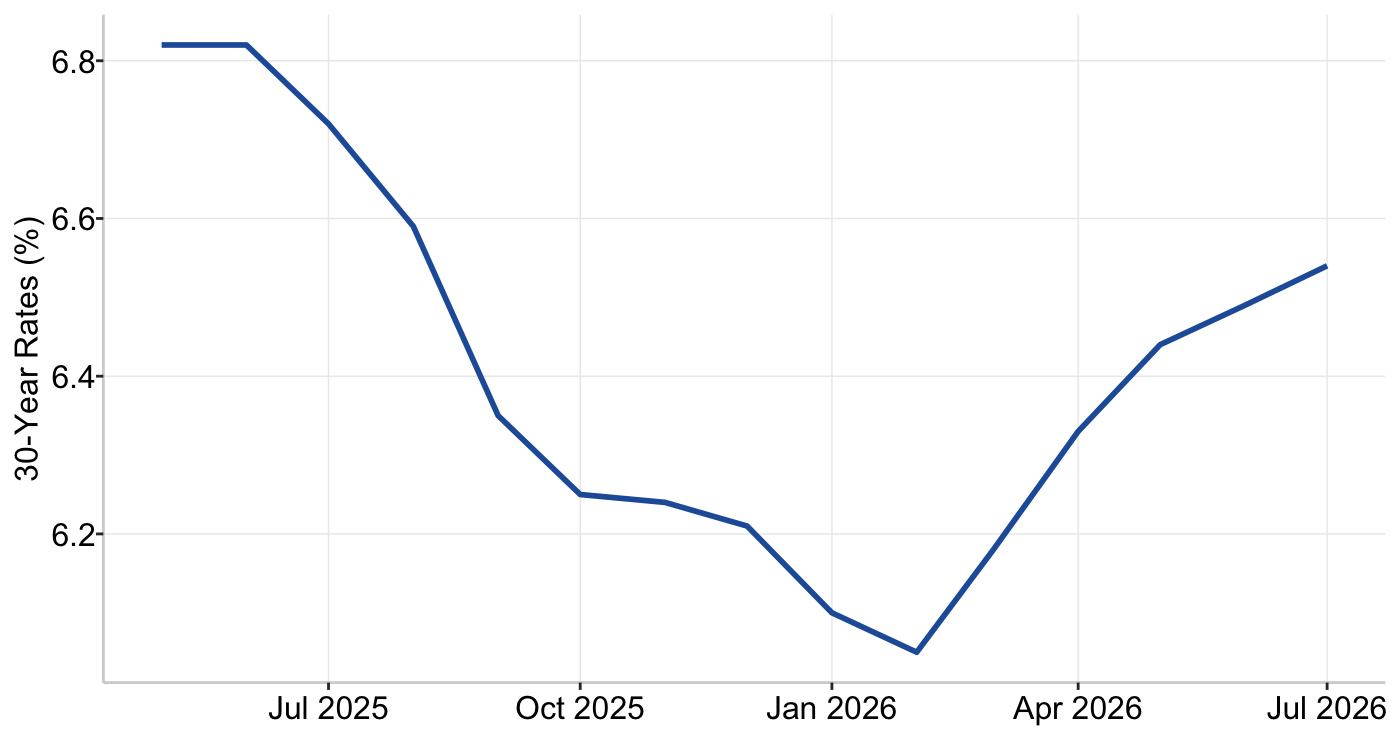
Graph 2: US 30-Year Mortgage Rates
Source: FRED
At the same time, the historical diversification benefits of corporate bonds have weakened. The correlation between investment-grade corporate bonds and U.S. equities has increased from 0.13 before 2020 to 0.63 since 2020, reducing their effectiveness as a portfolio hedge. As a result, institutional investors are turning to asset-backed finance, where investments are backed by pools of real assets rather than the financial performance of a single company.
U.S. mortgage rates continued to climb this past month, reaching their highest level in a year as rising inflation concerns pushed Treasury yields higher. The average 30-year fixed mortgage rate increased to 6.66%, its highest level since August 2025, further reducing housing affordability. If markets continue to expect interest rates to remain higher for longer, mortgage rates are unlikely to decline in the near term, creating additional challenges for prospective homebuyers.
Equities
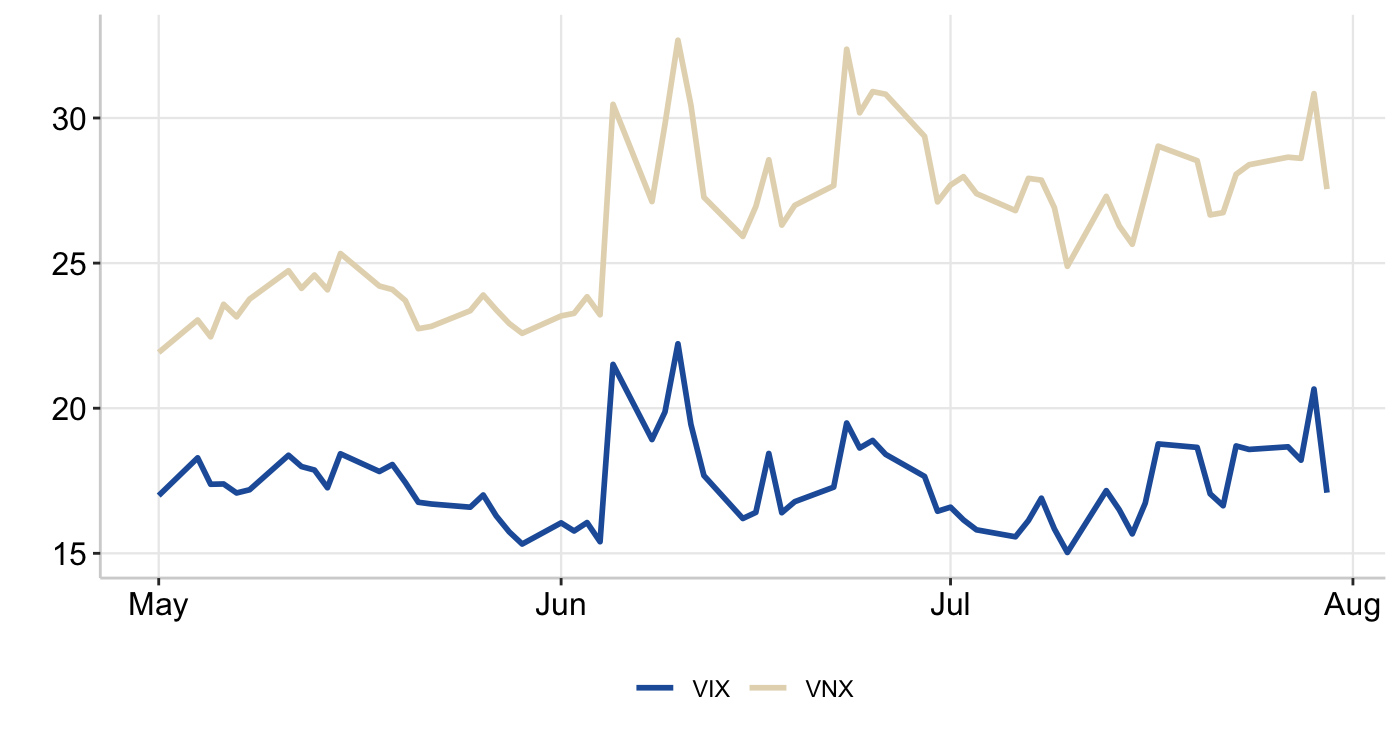
U.S. markets shifted from AI-driven optimism toward greater selectivity as investors questioned whether massive AI spending and elevated valuations can generate sufficient returns. The AI trade remains intact, but the market is demanding more proof of profitability, leading to volatility across semiconductor stocks and a rotation into financials, industrials and other sectors.
AI companies are expected to spend more than $725 billion on AI-related investments this year, raising concerns that spending is outpacing cash-flow generation causing semiconductor stocks to sell off sharply.
Graph 3: CBOE SPX & NASDAQ 100 Volatility Index
Source: FRED
The Nasdaq 100 underperformed as semiconductor and other AI-related stocks faced concerns, eventually entering a technical correction after falling roughly 11% from its June peak. While, the S&P 500 proved more resilient as capital rotated into other non-technology sectors.
By month-end, the AI narrative had become more balanced. Microsoft’s 16% surge following 43% Azure growth and Amazon’s 37% AWS growth provided evidence that AI infrastructure spending is translating into real business growth. The market therefore does not appear to be abandoning AI; rather, investors are becoming more selective and demanding that companies prove their AI investments can generate sustainable profits.
World Currencies
The U.S. dollar strengthened as a resilient U.S. economy and heightened uncertainty supported safe-haven demand. However, the dollar dropped 2.4%, the largest one-day decline since January 2023 following the Fed’s decision.
The Japanese yen remained under pressure, briefly weakening beyond ¥163 per dollar as wide interest-rate differentials and higher oil prices increased demand for dollars. However, the yen later surged toward ¥158 amid suspected government intervention and expectations that the Bank of Japan could raise rates. The British pound also gained after the Bank of England held rates in a hawkish 6–3 vote, while uncertainty remained over its next move.
Table 2: World Currencies Performance (Month-to-Date)
| USD | EUR | GBP | JPY | CAD | |
|---|---|---|---|---|---|
| USD | -1.0% | -1.7% | -3.0% | -1.3% | |
| EUR | 1.0% | -0.7% | -2.0% | -0.3% | |
| GBP | 1.7% | 0.7% | -1.3% | 0.4% | |
| JPY | 3.1% | 2.1% | 1.3% | 1.7% | |
| CAD | 1.3% | 0.3% | -0.4% | -1.7% |
Source: Koyfin
Meanwhile, China’s yuan remained closely managed by the PBOC, with concerns that it is being kept artificially weak to support exports. The IMF has argued that the yuan remains undervalued, highlighting continued tensions over China’s exchange-rate policy.
Real-World Assets (RWA) Outlook
RAAC backs its products with real-world assets (RWA), offering greater stability. The following section reviews the current market performance of each underlying asset.
Real Estate Environment
The U.S. housing market continues to weaken as elevated mortgage rates pressure demand. Mortgage purchase applications fell 7.3%, with homes staying on the market longer and sellers outnumbering buyers by nearly 500,000. High borrowing costs continue to constrain affordability, creating a two-speed market where luxury home sales are outperforming while starter-home sales decline. However, housing starts rose 19% to a 1.43 million annualized rate, driven by a 76% rebound in multifamily construction, while single-family starts remained weak. Overall, affordability remains a challenge as financing costs stay elevated.
Commodities overview
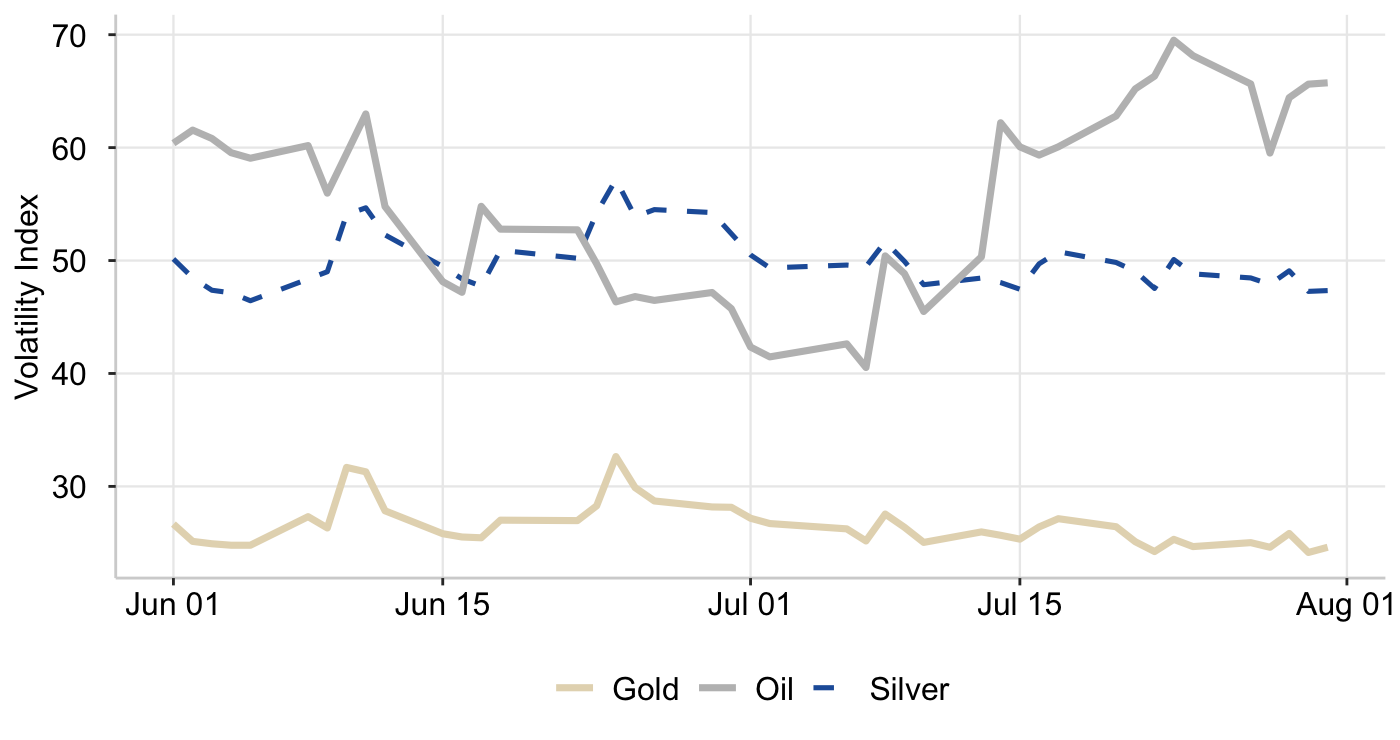
Oil prices were highly volatile throughout the month as markets responded to shifting US-Iran tensions and disruptions around the Strait of Hormuz. Renewed conflict pushed Brent above $100/barrel as geopolitical risk escalated. Prices later reversed as tensions eased and supply concerns diminished, with Brent experiencing its worst three-day decline since 2020 and WTI falling 8.4%. Lower oil prices provided relief for inflation expectations and supported equities, although prices remained volatile as markets continued to monitor geopolitical developments and the outlook for global demand, particularly from China.
Gold remained under pressure throughout the month as expectations for higher-for-longer interest rates outweighed its traditional safe-haven appeal. Strong economic data pushed Treasury yields higher, increasing the opportunity cost of holding non-yielding gold, while renewed Middle East tensions and higher energy prices reinforced inflation concerns. Gold fell roughly 3% in mid-July and remained near the $4,000/oz level, with the metal down about 14% in Q2 and more than 20% since the US-Iran war began.
Graph 4: CBOE Commodities ETF Volatility Index
Source: CBOE
However, gold has found strong support around $4,000 as investors bought the dip and expectations for an immediate Fed hike weakened. The dollar’s decline also supported bullion by making it cheaper for foreign buyers. Gold briefly climbed to $4,112/oz at month-end, with $4,200 emerging as a key level for renewed momentum. Overall, gold remains caught between persistent inflation and geopolitical risks.
Silver outperformed gold as dip-buying and renewed geopolitical tensions supported precious metals, with silver rising as much as 5% toward $60/oz. Unlike gold, silver also benefited from stronger industrial-metals sentiment, giving it an additional source of demand.
Decentralized Finance (DeFi) Outlook
Cryptocurrencies
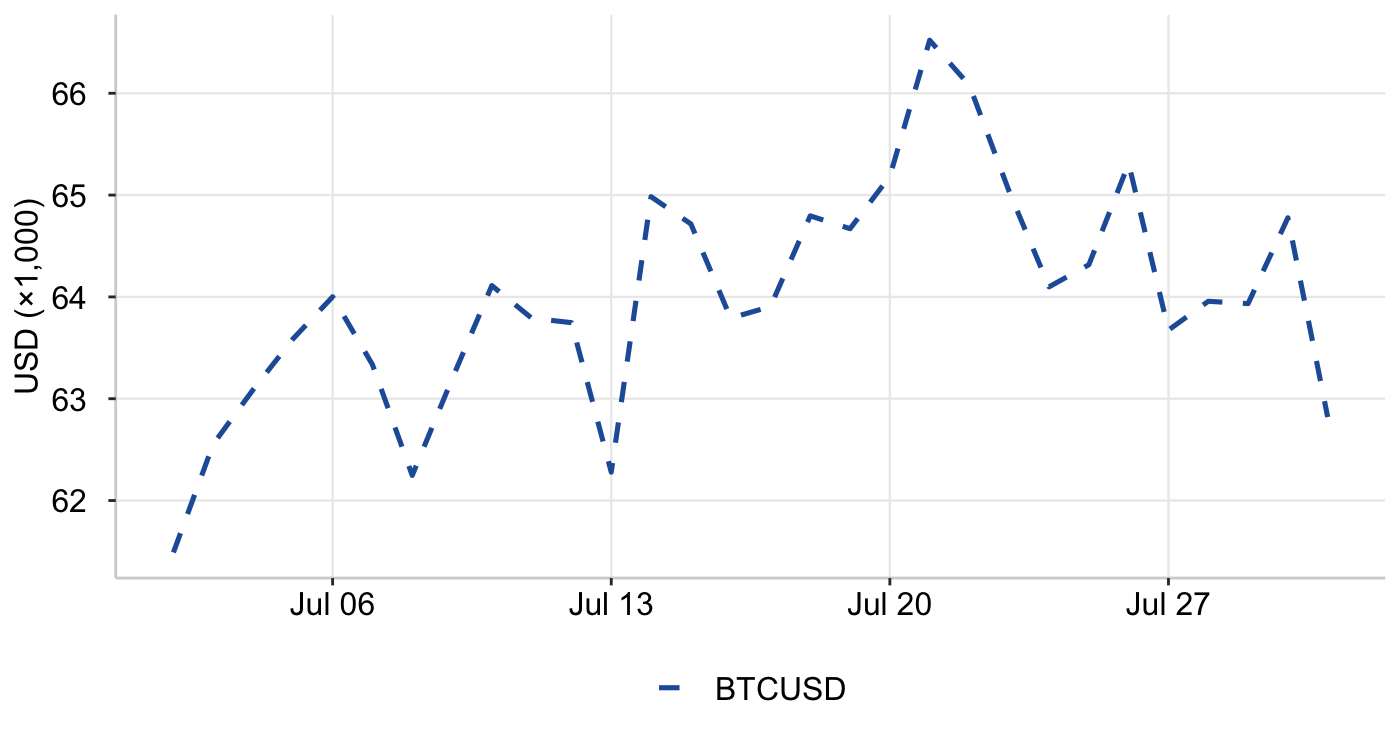
Bitcoin (BTC) traded between $61,500 and $66,500 this month and has remained within this range since June. Long-term investors and institutions have resumed accumulating Bitcoin, with long-term holders purchasing roughly 31,800 BTC per day between June 20 and July 6. At the same time, U.S. spot Bitcoin ETFs recorded more than $500 million in inflows for three consecutive trading days, following significant outflows in June.
Overall, Bitcoin ETF flows turned positive this month, while Ether (ETH) ETFs also began attracting inflows. Together, these improving fund flows and renewed institutional accumulation could provide early evidence that the market is forming a bottom.
Graph 5: BTC/USD
Source: Thetie
Bitcoin is showing many of the technical and fundamental characteristics that have marked previous market bottoms. It has spent roughly five months consolidating within a trading range, and historically Bitcoin has formed market bottoms gradually over several months rather than a dramatic selloff. The 200-week moving average remains one of Bitcoin's most closely watched long-term technical indicators. Having recently moved back above this level, many traders view it as an encouraging sign that long-term market sentiment may be improving.
The Clarity Act before Congress's August recess could help improve investor confidence. To pass the act, Republicans need support from at least seven Democratic senators, but they are putting forward numerous concerns over the bill. Morgan Stanley has expanded their platform E*Trade into crypto assets. Along with a number of other updates, the platform now allows clients to access Bitcoin, Ethereum, and Solana as many traditional finance companies continue to move into cryptocurrencies. Robinhood is expanding on their previous crypto investments by launching a public mainnet “Robinhood Chain” allowing customers to trade their tokenized stocks 24/7 and earn yield in Robinhood Earn.
Stablecoins
Stablecoins are cryptocurrencies that are commonly held because they offer lower volatility than Bitcoin and Ethereum, allowing users to preserve capital while remaining active on-chain. RAAC issues its own stablecoin, Precious-Metal USD (pmUSD), which operates on the Ethereum blockchain.
The total stablecoin market capitalization has reached approximately $308 billion, and analysts believe stablecoin circulation could grow to $1.45 trillion by 2035. U.S. dollar-pegged stablecoins, Tether (USDT) and USD Coin (USDC), remain the dominant assets within the ecosystem, accounting for ~82% of the market as dollar-backed stablecoins continue to serve as the global standard. Beyond the U.S. dollar, Circle's euro-denominated regulated stablecoin (EURC) has a market capitalization of $455 million, while the tokenized British pound (tGBP) has a market capitalization of $34 million.
The Ethereum network hosts ~$147.47 billion in stablecoin supply, representing roughly 49.4% of the global market, and continues to serve as the leading blockchain for stablecoin issuance and activity. The following table compares the market capitalizations of the major stablecoins alongside the currencies currently paired with pmUSD.
Table 3: 1 Month Market Capitalization
| Stablecoin | Position | Market Capitalization |
|---|---|---|
 pmUSD pmUSD |
73 | $43.96M |
 USDT USDT |
1 | $183.215B |
 USDC USDC |
2 | $73.065B |
 PYUSD PYUSD |
9 | $2.692B |
 crvUSD crvUSD |
33 | $225.96M |
 frxUSD frxUSD |
51 | $103.55M |
 OUSD OUSD |
152 | $6.02M |
| Source: DefiLlama |
The United States and the United Kingdom have announced a joint initiative to create a clear regulatory pathway for stablecoins in either country. Instead of competing, regulators want a compatible framework to make it easier for compliant stablecoins to operate across both companies. Major US banks are building a shared blockchain-based payment network to compete with stablecoins. Their goal is to create tokenized bank deposits, which combine the benefits of blockchain technology with the trust and regulation of the traditional banking system. This is an attempt to prevent stablecoins from replacing bank deposits and becoming the dominant form of digital money.
Visa has launched the Visa Stablecoin Platform (VSP), a new infrastructure platform that allows banks, fintechs, and financial institutions to issue, transfer, and manage stablecoins .The platform will initially support Open USD, a new stablecoin issued by the Open Standard consortium. Open USD is designed to encourage widespread adoption among financial institutions. Open USD will eliminate minting fees, eliminate redemption fees and return most reserve income to distribution partners.
Circles shares have declined 6%, while USDC circulation has fallen since reaching nearly $80 billion in March. JPMorgan noted that Circle's long-term economics may weaken due to a new agreement between Hyperliquid and Coinbase, which will result in Circle receiving a smaller share of earnings compared with previous arrangements. As a result, even if USDC supply continues to grow, profitability may not increase at the same pace. Meanwhile, Tether invested $20 million in Argentine digital bank Ualá as part of the company's $197 million funding round, expanding its presence in Latin America's fintech sector. However, there are currently no short-term plans to integrate USDT into Ualá's platform, as Tether is participating solely as a financial investor.
RAAC Outlook
Precious-Metal USD (pmUSD)
Precious-Metal USD (pmUSD) is RAAC’s stablecoin, designed to bridge hard-asset collateral with decentralized finance liquidity. pmUSD is backed by gold through tokenized in-situ precious metals reserves. Its issuance is backed by $121.98 million in collateral provided by I-ON Corporation, giving investors exposure to a fully collateralized, gold-backed digital asset on-chain while unlocking secure platforms to earn yield on tokenized gold.
Market capitalization declined 33.89% to $43.91 million as pmUSD remained depegged from its $1.00 USD target. The token traded at an average monthly price of approximately $0.65, but declined further to $0.42 toward the end of the month as investors awaited the delayed redemption process. The delay was attributed to global macroeconomic events that diverted the attention of the key counterparty involved in the redemption facility.
Despite these external constraints, RAAC continues to actively monitor the situation and remains committed to implementing the $8 million redemption facility, providing holders with a clear pathway to redeem pmUSD for physical gold-related value through recognized partners.
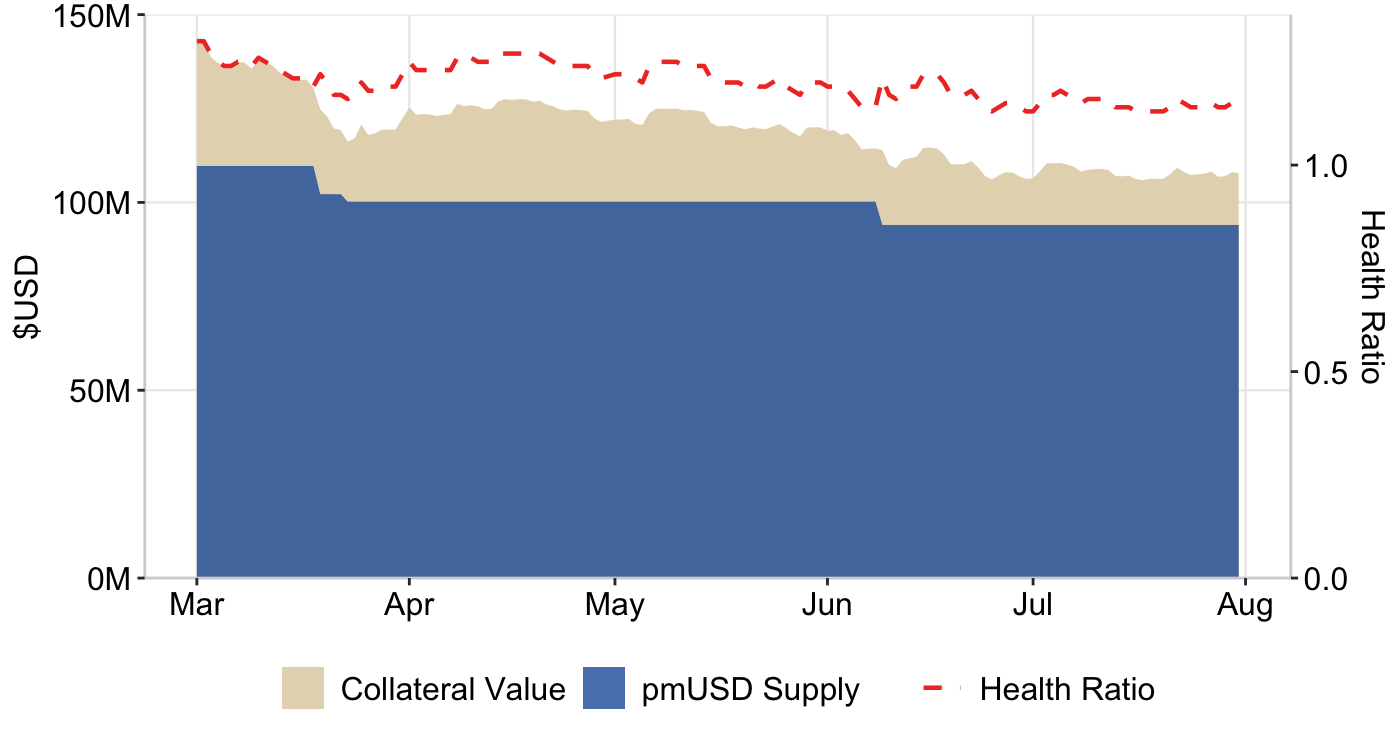
Table 6: Collateral vs pmUSD supply
Source: https://dune.com/4sh4/raac-pmusd
Although gold prices have fluctuated, RAAC has maintained a stable health ratio relative to its collateral value and circulating pmUSD supply. Throughout July, collateral value averaged $107.95 million, while pmUSD supply averaged approximately $94 million, resulting in an overcollateralization ratio of 1.15. In March and June, RAAC reduced pmUSD supply to maintain strong collateral coverage and preserve system stability as gold prices entered a period of weakness. In June, $6.2 million was burned and following this adjustment, gold prices could decline to ~$3,900/oz before any additional action would be required from RAAC.
$iREET
The Index Real Estate Token ($iREET) is RAAC’s tokenized real estate index, and is designed to give users liquid, diversified exposure to real-world real estate on-chain, positioning $iREET as a competitive real-estate-backed product in DeFi, supported by sustained yield opportunities.
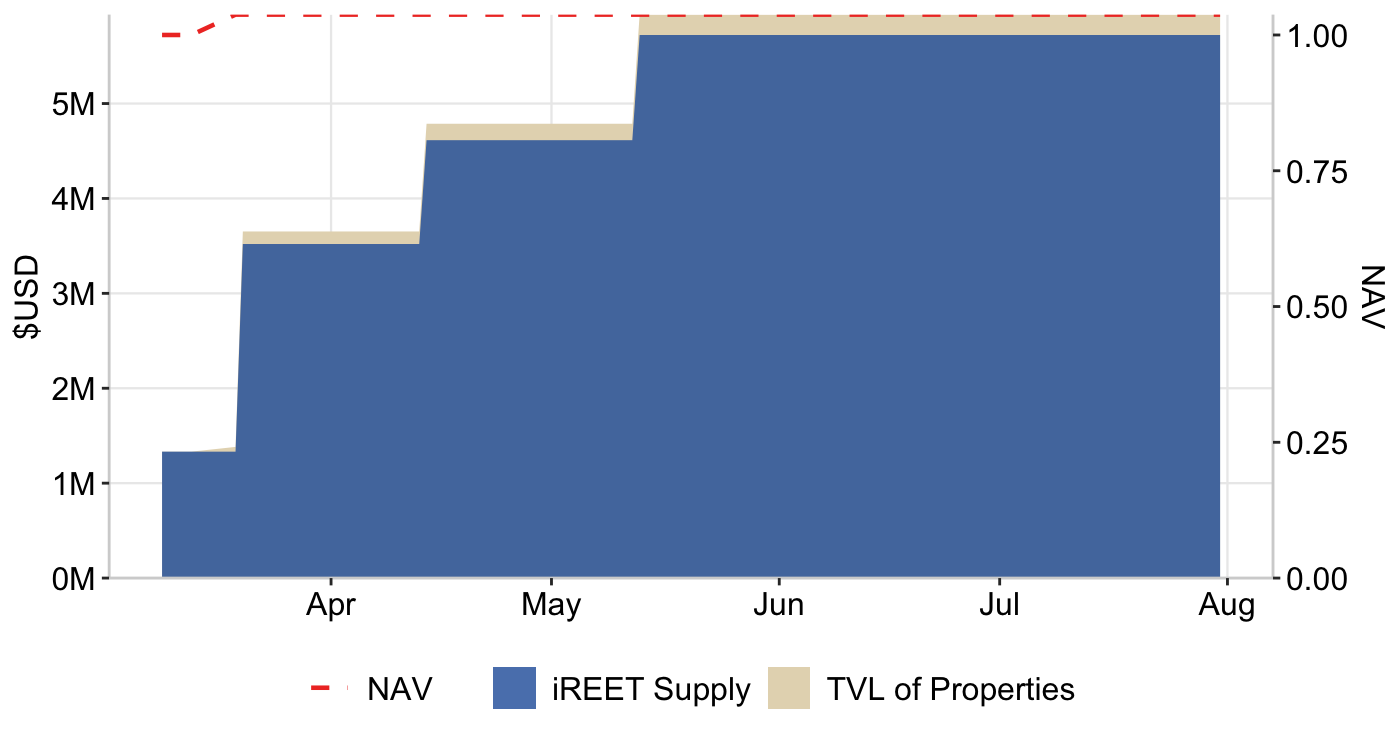
Graph 7: NAV per $iREET
Source: Dune
Notes: NAV per $iREET = TVL / Circulating Supply
RAAC has continued acquiring properties to increase the value of the index and plans to expand the portfolio further. The iREET vault now holds 17 properties with a combined value of $5.94 million, supporting a circulating supply of 5.72 million iREET tokens. The net asset value (NAV) per iREET is $1.0375, below the current market price of $1.1153.
RAAC has generated $174,971 in protocol revenues from rental income in 2026 so far, with the properties generating $42.7K in monthly rental income, which flows back into and further strengthens RAAC's lending ecosystem. Additionally, RAAC also earns fees from Curve. Over the past month, RAAC has added ~$912 USD worth of iREET fees back into its liquidity pools, further supporting liquidity depth and yield generation.
Glimpse into the Curve Wars
RAAC is built directly within Curve Finance and actively participates in the Curve Wars, the ongoing competition to control governance power within the protocol. By locking CRV tokens, participants receive vote-escrowed CRV (veCRV), which grants voting rights to determine which liquidity pools receive reward emissions, ultimately shaping yield levels and liquidity depth. Protocols such as Convex Finance and Stake DAO have accumulated significant veCRV positions and, through their own tokens, offer alternative pathways to access Curve governance power.
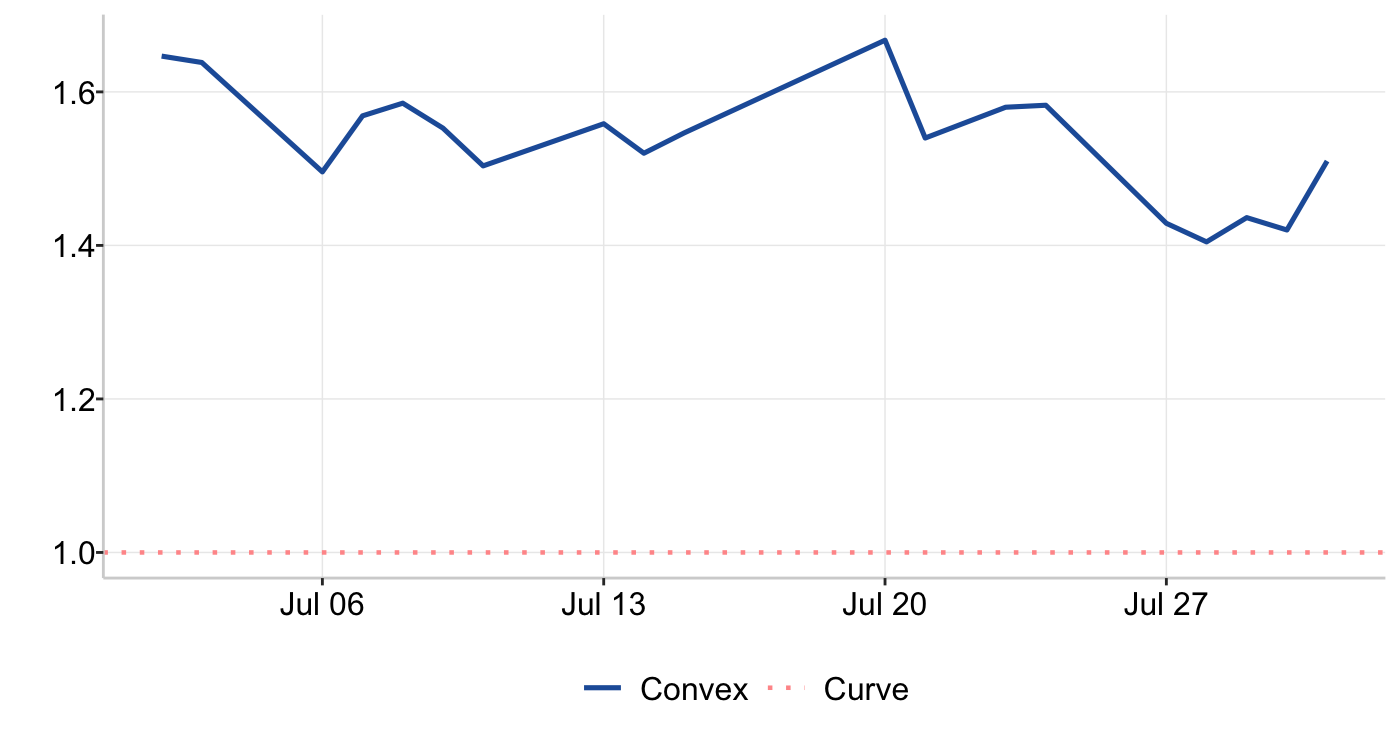
The Kingmaker Ratio is a RAAC-specific metric used to evaluate whether acquiring veCRV directly or accumulating voting power through another protocol is the most efficient strategy per dollar. The metric is defined as:
Kingmaker Ratio = veCRV/$ via protocol iveCRV/$ via CRV
Using the above equation, the ratio is calculated for Convex (vlCVX). While Stake DAO is another viable route, it is better suited for individual users rather than the protocol itself. Graph 6 tracks the evolution of this ratio over the past month, highlighting changes in relative efficiency. The Convex ratio remained larger than 1, reinforcing Convex as the most capital-efficient route, with higher voting power per $1 spent compared to direct veCRV acquisition. This strategy has enabled RAAC to build significant governance influence.
Graph 6: Kingmaker Ratio
Source: buycvxcorrect.netlify.app
Liquidity pools
RAAC has 4 liquidity pools active on Curve Finance:
- pmUSD/crvUSD - Launched Dec 25, 2025
- pmUSD/frxUSD - Launched Dec 25, 2025
- pmUSD/OUSD - Launched Feb 28, 2026
- iREET/pmUSD - Launched Mar 12, 2026
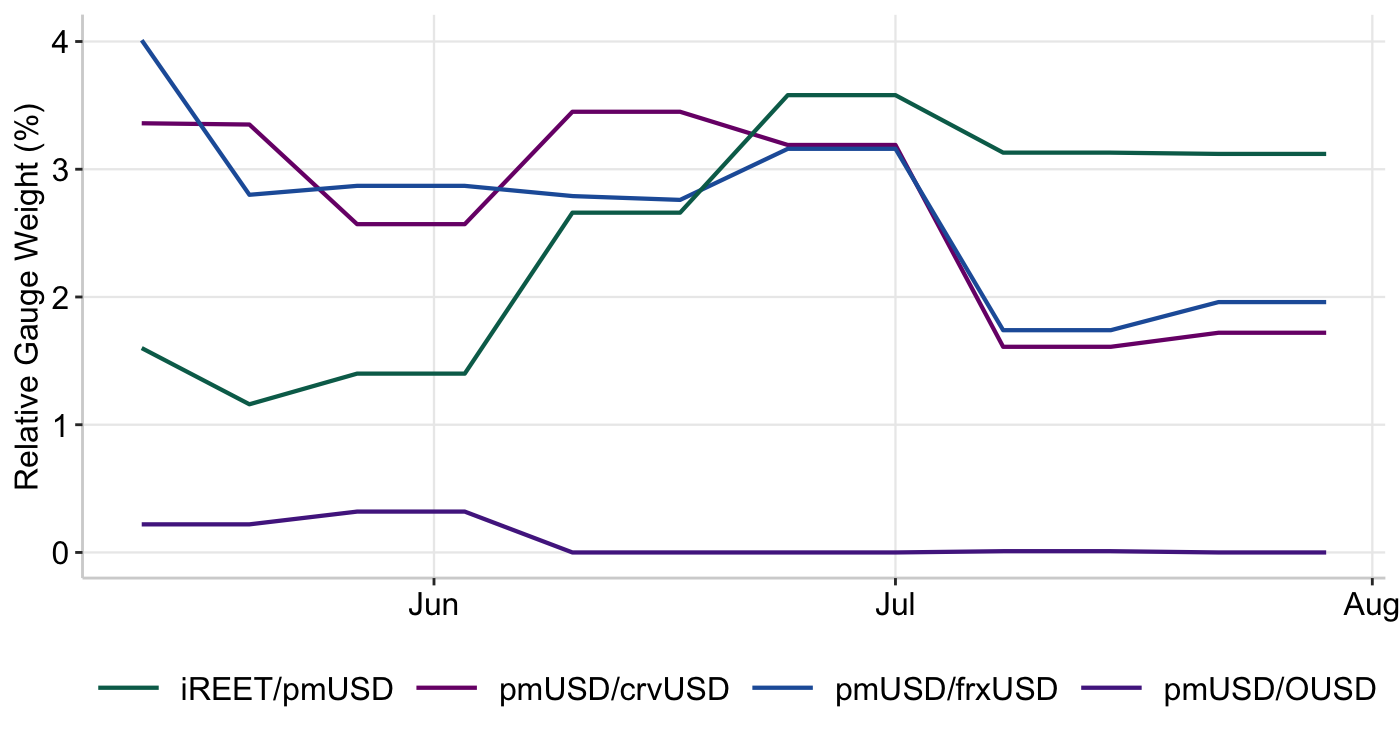
RAAC is built on the existing Curve Finance infrastructure and ecosystem, including active participation in the Curve Wars. Through this participation, RAAC has directed liquidity to its Curve pools. Graph 9 illustrates the relative gauge weight of RAAC’s liquidity pools within the Curve Finance ecosystem.
Graph 9: RAAC Curve Pools - Gauges
Source: curve.finance
While RAAC's own voting power provides a base gauge weight of 4.49%, the protocol achieved 6.80% total veCRV gauge weighting. Based on a CRV price of $0.211, this equates to approximately $68,678 in CRV emissions directed toward RAAC's Curve pools, allowing for competitive yields.
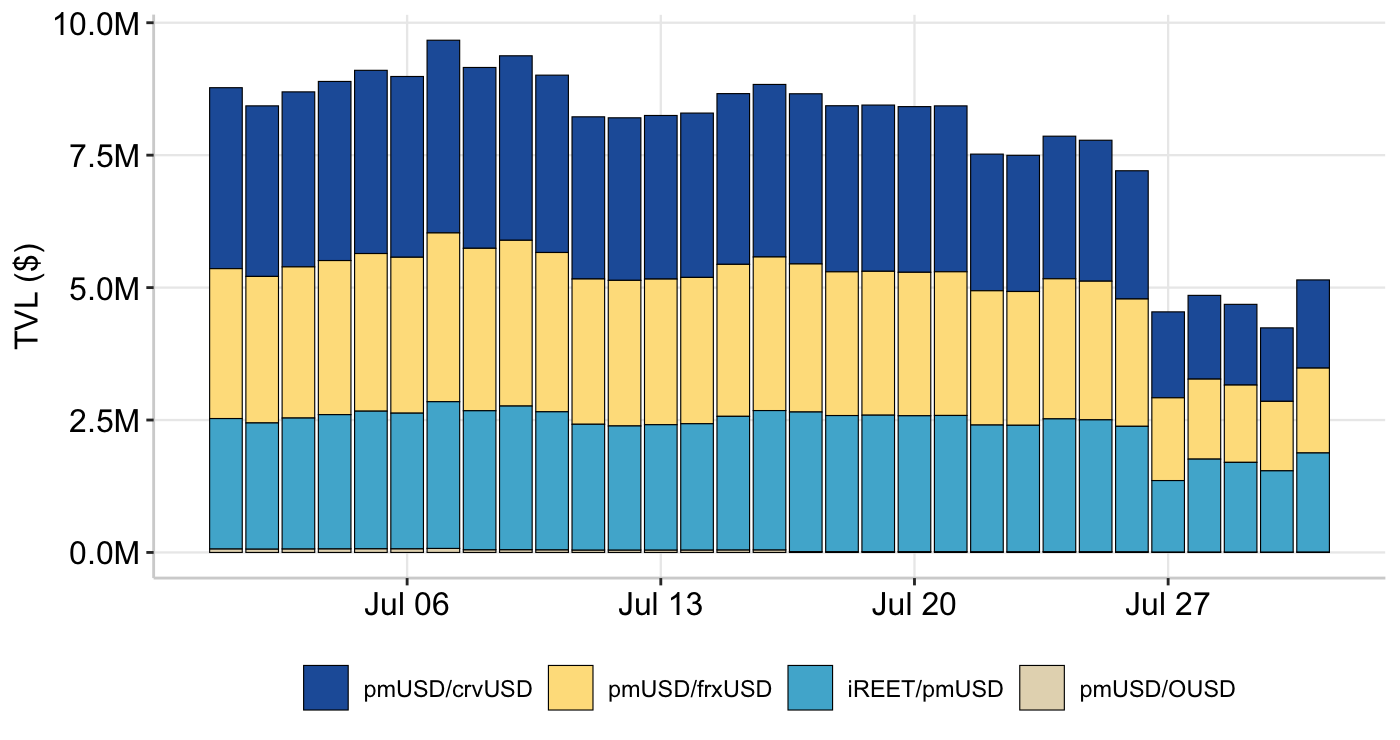
RAAC’s Curve pools maintained an average combined Total Value Locked (TVL) of $7.8 million throughout the month, although TVL declined toward month-end due to pmUSD price depreciation and liquidity providers withdrawing funds. Despite the decline, the three most established pools maintained an average TVL of over $2 million each during the month.
Graph 10: RAAC Curve Pools - Total Volume Locked (TVL)
 Source: https://dune.com/4sh4/raac-pmusd
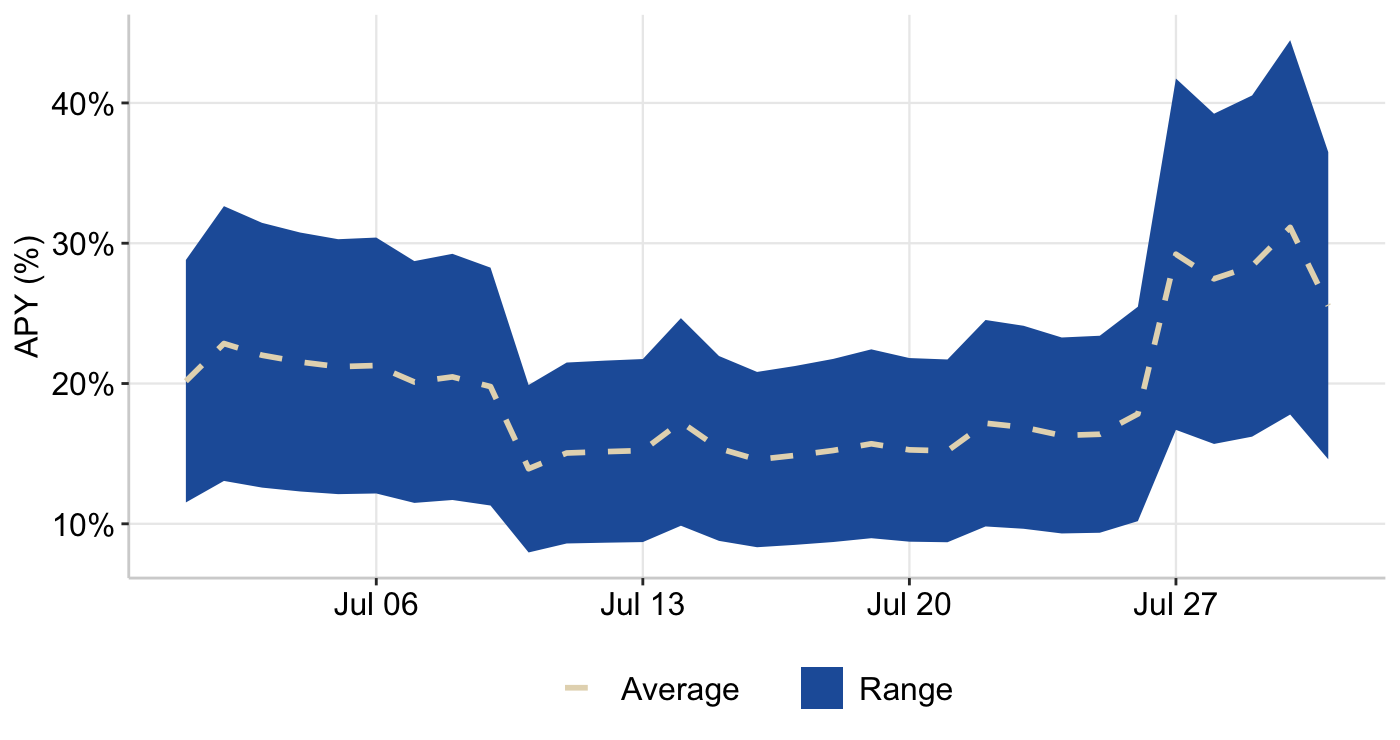
The weighted reward APY across RAAC’s Curve liquidity pools ranged from 7.9% to 44% over the past month, with average yields increasing compared with the previous month. The iREET/pmUSD pool currently offers the highest returns after receiving the majority of RAAC’s voting incentives, resulting in APYs ranging from 13.5% to 64% and an average yield of 27%. The remaining Curve pools also continue to offer competitive yields, with both the pmUSD/crvUSD and pmUSD/frxUSD pools reaching maximum APYs of 34%–40%.
Figure 11: RAAC Curve Pools - Weighted Reward APY
Source: curve.finance
Nonetheless, the yields offered across RAAC’s Curve pools continue to be highly competitive, with the iREET/pmUSD pool remaining the primary driver of active yield opportunities. This demonstrates that the protocol’s voting and incentive strategy is functioning as intended even under stressed market conditions.
Participants can further enhance their yields by depositing LP tokens into protocols such as Stake DAO, Convex Finance, Beefy Finance, and Yearn Finance to access boosted rewards. RAAC has also partnered with Royco Protocol and Euler Finance to further expand return opportunities for participants.
Resources
Data
https://tradingeconomics.com/indicators
https://fred.stlouisfed.org/series/DGS10
https://fred.stlouisfed.org/series/DGS5#
https://fred.stlouisfed.org/series/DGS30)
https://fred.stlouisfed.org/series/BAMLC0A0CM#
https://fred.stlouisfed.org/series/PRIME
https://fred.stlouisfed.org/series/MORTGAGE30US
https://app.koyfin.com/gyld
https://fred.stlouisfed.org/series/VIXCLS
https://defillama.com/stablecoins
https://www.coingecko.com
https://www.cboe.com/us/indices/dashboard/ovx-GVZ/
https://www.cboe.com/us/indices/dashboard/ovx/
https://www.convexfinance.com/
https://dune.com/4sh4/raac-pmusd
https://www.curve.finance/dao/ethereum/gauges
https://www.curve.finance/dex/ethereum/pools?search=pmusd
https://www.stakedao.org/yield?search=pmusd
https://curve.convexfinance.com/stake
https://app.beefy.com/
https://yearn.fi/vaults?type=lp&search=pmusd
https://app.morpho.org/ethereum/market/0x72cc79433e9f91c2a185422725510f4bdd19c9006010f464f851468b2371b756/srroyusdc-pmusd?tab=market#advanced
News
https://finance.yahoo.com/markets/crypto/articles/robinhood-markets-launches-public-blockchain-135000798.html
https://ca.investing.com/news/forex-news/sterling-today-pound-firms-after-boe-keeps-rates-unchanged-4763969
https://www.reuters.com/world/asia-pacific/yen-strengthens-sharply-against-us-dollar-2026-07-30/
https://www.bloomberg.com/news/articles/2026-07-01/warsh-says-fed-charting-new-course-repeats-no-forward-guidance
https://www.bloomberg.com/news/articles/2026-06-30/asian-stocks-eye-gains-as-us-posts-stellar-quarter-markets-wrap
https://www.bloomberg.com/news/articles/2026-07-01/pimco-warns-private-credit-confidence-gap-to-reveal-weak-funds
https://www.bloomberg.com/news/articles/2026-07-01/asian-stocks-to-decline-as-traders-weigh-ai-warsh-markets-wrap
https://www.bloomberg.com/news/live-blog/2026-07-02/us-employment-report-for-june
https://www.bloomberg.com/news/articles/2026-07-02/gold-holds-gain-after-warsh-remarks-ease-fed-rate-hike-prospects
https://www.bloomberg.com/news/articles/2026-07-04/oil-s-stunning-reversal-rekindles-fears-of-a-global-glut
https://www.bloomberg.com/news/articles/2026-07-05/fewer-ships-transiting-hormuz-along-oman-coast-after-u-turns
https://www.bloomberg.com/news/articles/2026-07-05/stock-market-today-dow-s-p-live-updates
https://www.bloomberg.com/news/articles/2026-07-06/stock-market-today-dow-s-p-live-updates
https://www.bloomberg.com/news/articles/2026-07-07/tech-volatility-hits-highest-since-dot-com-bust-next-to-s-p-500
https://www.bloomberg.com/news/articles/2026-07-07/tech-rout-deepens-as-chipmakers-fall-spacex-gets-bullish-calls
https://www.bloomberg.com/news/articles/2026-07-07/oil-jumps-on-iran-attack-asian-stocks-set-to-drop-markets-wrap
https://www.bloomberg.com/news/articles/2026-07-08/nvidia-s-1-trillion-slide-sends-valuation-to-pre-ai-boom-levels
https://www.bloomberg.com/news/articles/2026-07-08/meta-to-build-first-data-center-in-canada-expanding-global-fleet
https://www.bloomberg.com/news/articles/2026-07-08/stock-market-today-dow-s-p-live-updates https://www.bloomberg.com/news/articles/2026-07-09/the-crypto-startup-trying-to-put-a-barrel-of-oil-on-blockchain
https://www.bloomberg.com/news/articles/2026-07-08/bitcoin-btc-weakens-as-trump-s-remarks-raise-fresh-iran-war-concerns
https://www.bloomberg.com/news/articles/2026-07-09/us-30-year-bond-auction-set-to-draw-highest-yield-in-20-years
https://www.bloomberg.com/news/articles/2026-07-09/gold-steadies-as-traders-weigh-mideast-fighting-rate-outlook
https://www.bloomberg.com/news/articles/2026-07-09/stock-market-today-dow-s-p-live-updates https://www.bloomberg.com/news/articles/2026-07-10/sk-hynix-indicated-to-climb-17-after-26-5-billion-adr-offering
https://www.bloomberg.com/news/articles/2026-07-12/oil-climbs-us-futures-dip-on-fresh-iran-strikes-markets-wrap https://www.bloomberg.com/news/articles/2026-07-10/stablecoin-firm-circle-gets-approval-for-coveted-us-bank-charter
https://www.bloomberg.com/news/articles/2026-07-12/traders-grapple-with-world-that-s-good-for-dollar-bad-for-bonds
https://www.bloomberg.com/news/articles/2026-07-13/bitcoin-weakens-as-oil-price-spike-revives-inflation-concerns
https://www.bloomberg.com/news/articles/2026-07-12/oil-climbs-us-futures-dip-on-fresh-iran-strikes-markets-wrap
https://www.bloomberg.com/news/articles/2026-07-14/s-p-500-futures-steady-ahead-of-inflation-data-warsh-testimony
https://www.bloomberg.com/news/articles/2026-07-14/us-cpi-falls-for-the-first-time-since-2020-core-gauge-unchanged
https://www.bloomberg.com/news/articles/2026-07-14/us-and-uk-pledge-to-embrace-stablecoins-more-in-regulatory-push
https://www.bloomberg.com/news/articles/2026-07-15/pimco-s-balls-favors-5-to-10-year-treasuries-as-fed-turns-quiet
https://www.bloomberg.com/news/articles/2026-07-14/asian-stocks-poised-to-track-us-gains-on-soft-cpi-markets-wrap
https://www.bloomberg.com/news/articles/2026-07-15/stock-market-today-dow-s-p-live-updates
https://www.bloomberg.com/news/articles/2026-07-15/warsh-says-price-pressures-from-ai-not-necessarily-inflationary
https://www.bloomberg.com/news/articles/2026-07-16/iran-us-skirmishes-worsen-as-hormuz-shipping-traffic-dwindles
https://www.bloomberg.com/news/articles/2026-07-15/tether-invests-20-million-in-argentina-s-uala-expanding-latin-america-push
https://www.bloomberg.com/news/articles/2026-07-16/mortgage-rates-in-us-rise-to-6-55-highest-since-august-2025
https://www.bloomberg.com/news/articles/2026-07-16/gold-heads-for-weekly-fall-as-hormuz-strikes-raise-fed-hike-bets
https://www.bloomberg.com/news/articles/2026-07-17/bitcoin-slump-why-crypto-token-halved-in-value-since-october-btc-usd
https://www.bloomberg.com/news/articles/2026-07-19/oil-climbs-as-middle-east-conflict-escalates-markets-wrap
https://www.bloomberg.com/news/articles/2026-07-20/bitcoin-etfs-log-second-week-of-inflows-breaking-two-month-rout
https://www.bloomberg.com/news/articles/2026-07-20/us-stocks-rebound-from-selloff-as-nvidia-other-chipmakers-rise
https://www.bloomberg.com/news/articles/2026-07-21/yen-slides-past-163-mark-to-fresh-four-decade-low-against-dollar
https://www.bloomberg.com/news/articles/2026-07-21/stock-market-today-dow-s-p-live-updates
https://www.bloomberg.com/news/articles/2026-07-17/us-housing-starts-rebound-on-multifamily-construction
https://www.bloomberg.com/news/articles/2026-07-22/us-30-year-yield-raises-alarm-in-longest-run-above-5-since-2007
https://www.bloomberg.com/news/articles/2026-07-22/stock-market-today-dow-s-p-live-updates
https://www.bloomberg.com/news/articles/2026-07-23/us-initial-jobless-claims-fall-to-lowest-level-since-1969
https://www.bloomberg.com/news/articles/2026-07-23/the-most-fundamental-macro-risk-is-back-macroscope-mrxj1md7
https://www.bloomberg.com/news/articles/2026-07-23/us-treasury-yields-rise-to-2026-highs-as-oil-gains-spark-fed-bet
https://www.bloomberg.com/news/articles/2026-07-27/bitcoin-etfs-end-inflow-streak-as-fed-rate-concerns-mount
https://www.bloomberg.com/news/articles/2026-07-22/senate-weighs-vote-on-high-stakes-crypto-legislation-next-week
https://www.bloomberg.com/news/newsletters/2026-07-21/bitcoin-s-bottoming-pattern-is-starting-to-take-shape
https://www.bloomberg.com/news/articles/2026-07-16/visa-is-expanding-its-crypto-push-with-new-stablecoin-platform
https://www.bloomberg.com/news/articles/2026-07-13/wall-street-mounts-pushback-on-trillion-dollar-stablecoin-boom
https://www.bloomberg.com/news/articles/2026-07-26/oil-tumbles-as-us-and-iran-pause-military-strikes-markets-wrap
https://www.bloomberg.com/news/articles/2026-07-27/corporate-bonds-lose-appeal-as-shock-absorber-carlyle-says
https://www.bloomberg.com/news/articles/2026-07-25/big-tech-debt-flood-is-taking-over-risk-in-market-credit-weekly
https://www.bloomberg.com/news/articles/2026-07-20/oracle-credit-risk-hits-near-18-year-high-on-ai-debt-load-angst
https://www.bloomberg.com/news/articles/2026-07-27/sk-hynix-s-rebound-from-470-billion-rout-hinges-on-ai-spending
https://www.bloomberg.com/news/articles/2026-07-28/crypto-s-24-7-playbook-comes-for-wall-street-s-beloved-ai-stocks
https://www.bloomberg.com/news/articles/2026-07-27/stock-market-today-dow-s-p-live-updates
https://www.bloomberg.com/news/articles/2026-07-28/s-p-500-futures-muted-as-semiconductors-drop-earnings-roll-in
https://www.bloomberg.com/news/articles/2026-07-28/nasdaq-100-heads-for-correction-as-ai-worries-rattle-investors
https://www.bloomberg.com/news/articles/2026-07-28/stock-market-today-dow-s-p-live-updates
https://www.bloomberg.com/news/articles/2026-07-23/us-treasury-calls-out-china-for-lack-of-transparency-on-currency
https://www.bloomberg.com/news/articles/2026-07-29/fed-holds-rates-steady-three-officials-dissent-favoring-a-hike
https://www.bloomberg.com/news/newsletters/2026-07-30/traders-are-doubting-warsh-s-resolve-on-inflation
https://www.bloomberg.com/news/articles/2026-07-30/treasuries-extend-drop-as-bond-traders-await-key-inflation-print
https://www.bloomberg.com/news/articles/2026-07-30/us-economic-growth-misses-estimates-despite-robust-consumers
https://www.bloomberg.com/news/articles/2026-07-30/microsoft-eyes-history-with-490-billion-pop-in-market-value
https://www.bloomberg.com/news/articles/2026-07-30/amazon-reports-fifth-straight-quarter-of-cloud-sales-growth
https://www.kitco.com/news/off-the-wire/2026-07-31/gold-slips-us-dollar-regains-footing-heads-first-monthly-gain-five
https://www.bloomberg.com/news/articles/2026-07-29/gold-advances-after-federal-reserve-keeps-interest-rates-on-hold
https://www.bloomberg.com/news/articles/2026-07-30/gold-holds-gain-as-japan-currency-intervention-weighs-on-dollar
https://www.bloomberg.com/news/articles/2026-07-20/gold-steady-as-traders-watch-middle-east-war-for-inflation-clues
https://www.coindesk.com/business/2026/07/14/jpmorgan-says-hyperliquid-s-rise-threatens-circle-s-usdc-economics