
Real Estate, Reimagined: Unlocking Property Through Tokenization
In this article, we continue our discussion of real-world asset (RWA) tokenization, shifting our focus to real estate. We examine the market's growth, emerging use cases, major protocols, and the opportunities tokenization creates for investors and the broader DeFi ecosystem.
What Is Tokenized Real Estate?
Real estate is one of the world’s largest asset classes, yet high capital requirements, illiquidity, and inefficient transaction processes can limit investor participation. Tokenized real estate uses blockchain technology to represent property ownership, addressing some of the structural barriers of traditional real estate investment. By enabling fractional ownership, lowering barriers to entry, and improving transaction efficiency, tokenization creates new opportunities for investor participation.
Tokens are created on-chain to represent ownership or synthetically replicate the price or performance of an underlying real estate asset, providing investors with exposure to property without requiring direct ownership. These digital representations can take different forms, including non-fungible tokens (NFTs), which record property ownership and asset-specific information, or fungible tokens, which enable fractional ownership and broader investor participation.
Use Cases and Protocols
Currently, more than $155 million in real estate value is represented across the tracked protocols. Reental represents the largest share, with $128.13 million in tokenized real estate, primarily through its single-property investment model. T-Rize Group is the second largest with $23 million, offering fractional exposure to multi-family residential properties and is followed by RAAC at $5.9 million through its tokenized REIT-equivalent asset.
Beyond being held in investor wallets, real estate tokens are being integrated into the broader DeFi ecosystem. Through third-party applications, these assets can be deployed into liquidity pools, used as collateral for borrowing and lending, or integrated into yield-generating strategies. This creates additional utility for tokenized real estate.
Market Growth and Investor Adoption
Tokenized real estate is gaining traction, although the market remains in its early stages. It currently represents ~0.50% of the overall tokenized real-world asset market. Despite its relatively small share, the sector has experienced notable growth over the past year.
While total on-chain value captures the full value of tokenized real estate across tracked blockchains, Distributed Value measures the value of real-world assets made available to investors through blockchain-based distribution. The following chart illustrates the cumulative distributed value of tokenized real estate.
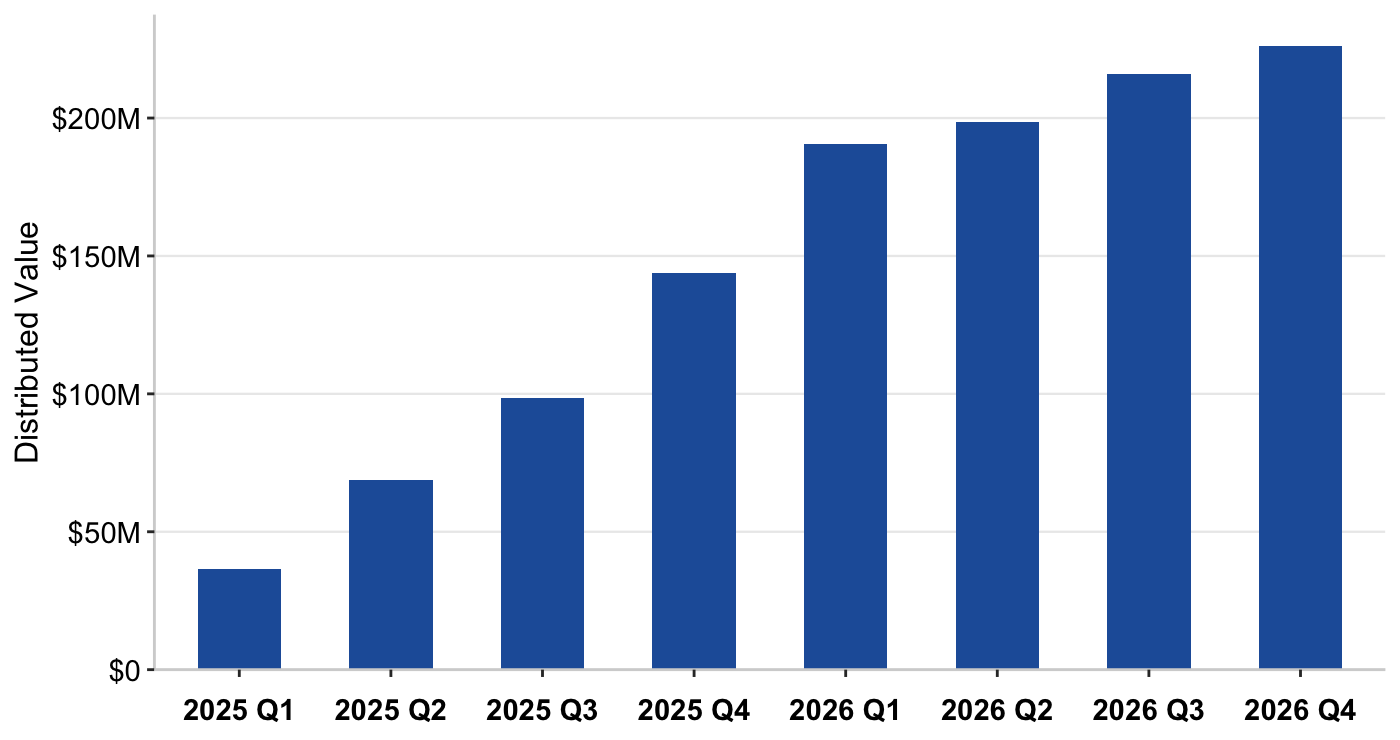
The market has experienced substantial expansion, with average distributed value increasing from $36.52 million in Q1 2025 to $215.87 million in Q3 2026. This represents an increase of 491%, with growth pronounced between Q2 and Q4 2025. Although the pace of expansion moderated in 2026, distributed value continued to increase, reflecting the ongoing development of blockchain-based infrastructure for real estate investment and ownership.
Growth is also supported by increasing institutional interest and longer-term market projections. Citigroup estimates that global tokenized real estate exposure could reach $200 billion by 2030 as infrastructure, distribution channels, and investor familiarity improve. Furthermore, the allocation of tokenized assets within real estate portfolios is projected to increase from 1.3% in 2023 to 6.0% by 2027 (1). Institutional and high-net-worth investors have also identified real estate as one of their most preferred tokenized alternative asset classes, ranking it first or second, closely behind private equity.
While tokenized real estate remains relatively small compared to other tokenized asset classes, growing investor interest and expanding on-chain infrastructure point to its increasing role in the digital asset ecosystem. Beyond fractional ownership, tokenization creates opportunities to integrate real estate into decentralized financial markets, where tokenized property interests can be deployed in liquidity pools, used as collateral, or incorporated into other financial applications.
This represents a fundamental shift in how real estate can function as an asset: rather than remaining a static investment held in a wallet, tokenized property can become an active financial instrument, unlocking liquidity and expanding its utility without requiring investors to sell their underlying exposure.
Resources
- https://www.ey.com/en_lu/insights/real-estate-hospitality-construction/real-estate-tokenization-a-new-era-for-property-investment-and-luxembourg-s-strategic-role
- https://defillama.com/rwa/category/real-estate
- https://chain.link/education-hub/tokenized-real-estate
- https://coinmarketcap.com/academy/article/tokenized-real-estate-what-does-it-mean
- https://app.rwa.xyz/real-estate
- https://www.citigroup.com/rcs/citigpa/storage/public/Citi_Institute_GPS_Report_Tokenization_2030.pdf
- https://www.reental.co/en
Disclaimer
The services and products offered by RAAC discussed herein are not available to U.S. persons. This blog post is not intended to offer or to promote the offer or sale of these products and services in the United States or to U.S. persons.