
Tokenizing Commodities: Connecting Physical Assets to Digital Finance
In our previous article, we introduced the concept of tokenization and how it connects real-world assets to blockchain-based financial markets. Building on that overview, this report examines tokenized commodities, their market growth, the participants driving adoption, and their emerging applications in digital finance.
What are tokenized commodities?
Tokenized commodities are digital tokens issued on a blockchain that represent ownership of, a contractual claim on, or price exposure to a physical commodity or commodity-related asset. The specific rights attached to each token depend on its legal and contractual structure.*
Market Growth
Tokenized commodities is the largest consumer class asset after the U.S. Treasury debt, reaching a market capitalization of $5.1 billion in October 2026. Market capitalization grew significantly over a two-year period, expanding 5x with the strongest growth between late 2025 to early 2026.
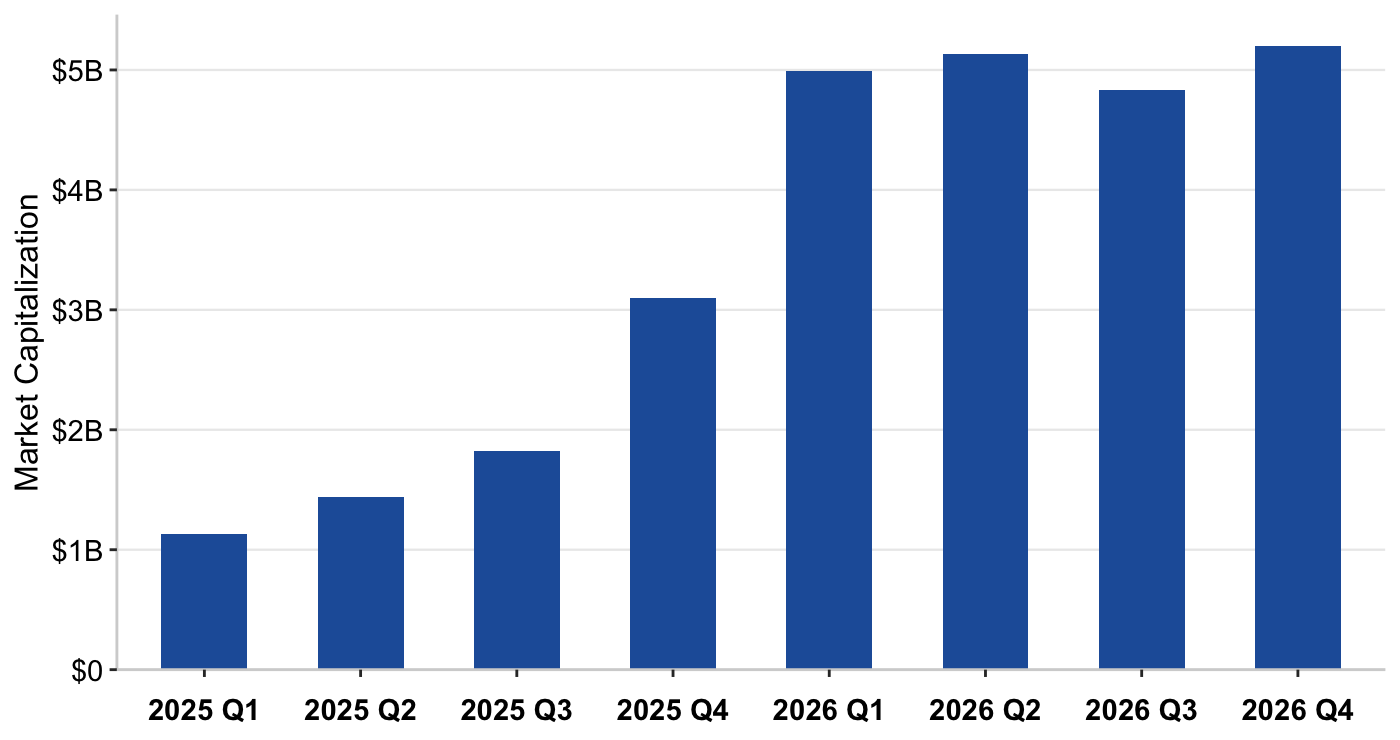
This expansion has been heavily anchored by tokenized precious metals, particularly gold products like Tether Gold (XAUT) and PAX Gold (PAXG), which account for the vast majority of current liquidity and investor demand. The following breakdown illustrates the relative size of these categories as of October 2026.
Figure 2: Tokenized Commodity Market Cap. and Category Share (October 2026)
| Category | Market capitalization (USD) | Share of total |
|---|---|---|
| Precious metals | $5,113,252,450 | 99.79% |
| Energy | $9,800,553 | 0.1913% |
| Agriculture | $96,477 | 0.0019% |
| Industrial metals | $104,642 | 0.0020% |
| Others | $630,704 | 0.0123% |
Source: RWA.xyz. Notes: “Precious Metals” include Gold, Silver, Platinum, and Palladium. “Energy” includes Crude Oil (WTI & Brent), Natural gas, and Oil and Gas Interests. “Agriculture” includes wheat. “Industrial metals” include copper. “Others” include diversified commodities, gemstones and commodity-linked financial strategies.
Precious metals dominate the market, with them accounting for 99.79% of total tokenized commodity market capitalization. In the near future, the market is likely to remain heavily concentrated in precious metals as established institutions explore ways to use gold more productively for on-chain lending and borrowing. Although silver remains a much smaller segment than gold, it is also expanding rapidly.
Energy and other commodity-linked products account for the remaining 0.21% of market capitalization and are beginning to gain traction. However, these categories remain at an early stage compared to tokenized gold, which gained an early advantage through its adoption in 2021. Tokenized energy is also beginning to emerge, but it remains uncertain how quickly it can follow the growth of tokenized metals as energy tokens are harder to build and properly integrate.
Industry executives forecast substantial growth in tokenized commodities, with market value potentially reaching tens of billions of dollars within five years and exceeding $100 billion within a decade. Over a 15-year horizon, tokenization could become integrated into routine commodity settlement and financing.
Who Holds Tokenized Commodities and why?
Three types of participants are driving current adoption, each with a different motivation.
- Retail investors want commodity price exposure without the friction of physical ownership, including storage, transportation, and minimum lot sizes. A tokenized gold position offers a more accessible way to gain exposure to gold, while allowing investors to hold their assets through on-chain self-custody.
- Institutional allocators are using tokenized commodities as a portfolio diversification tool. In an environment of elevated yields and persistent inflation, gold-linked digital assets offer a familiar hedge in a more composable digital format.
- Commercial participants, including commodity businesses, traders, and processors, represent another source of demand. For them, tokenization can serve as an operational tool by digitizing commodity-related contracts, enabling faster settlement, and reducing counterparty friction.
Beyond Price Exposure
The commodity tokenization market is still in its gold phase, and for good reason. Gold has the most mature trust infrastructure: established verification, global custody networks, and a centuries-long track record as a store of value.
The real next phase is about making gold productive on-chain: moving beyond price exposure into collateral, lending, and yield generation. That’s where the infrastructure buildout is happening, and where the gap between holding gold and deploying gold starts to close.
Footnote: *Not every token associated with a commodity represents direct ownership of the underlying physical asset. Depending on its structure, a token may represent ownership of a commodity, a claim against an issuer responsible for holding or redeeming the asset, a contractual interest linked to commodity inventory or supply agreements, or price exposure through a derivative or other financial instrument. The legal rights and redemption arrangements associated with each token should therefore be assessed individually.
Resources
- https://www.coindesk.com/business/2026/10/05/tokenized-commodities-look-beyond-gold-as-lending-and-oil-open-new-markets
- https://cryptorank.io/insights/research/how-rwa-adoption-is-spreading-across-crypto-markets
- https://chain.link/article/tokenized-commodities
- https://www.forbes.com/sites/astanley/2026/07/02/the-tokenized-asset-market-is-60-billion-most-of-it-isnt-moving/
- https://www.chainalysis.com/blog/tokenized-real-world-assets-on-chain-commodities/
- https://nansen.ai/post/tokenized-commodities-trade-gold-oil-onchain
- https://app.rwa.xyz/
Disclaimer
The services and products offered by RAAC discussed herein are not available to U.S. persons. This blog post is not intended to offer or to promote the offer or sale of these products and services in the United States or to U.S. persons.