
The Next Stage of Tokenization: Productive Assets and On-Chain Yields
In our previous articles, we discussed what tokenization is and how it is expanding into real-world assets (RWAs), such as commodities and real estate. We continue the discussion by looking at how tokenization allows assets to become more productive and generate on-chain yields.
Introduction
Blockchain technology initially served a relatively small audience, but that same emerging infrastructure is now starting to support larger financial markets. As financial institutions move on-chain, traditional financial products are interacting with decentralized finance (DeFi) protocols and crypto-native assets. This transition is creating new financial primitives, such as automated market making, on-chain settlement, permissionless lending and yield tokenization.
Reshaping Market Structure
Traditional assets are continuing to migrate on-chain as blockchain infrastructure introduces applications that make them more functional and capital-efficient than traditional alternatives. Through its permissionless nature, users can participate without requiring approval from a central platform, allowing new products and markets to emerge more easily. Blockchain infrastructure also provides access 24 hours a day, seven days a week, creating opportunities for traders to react to market developments continuously.
Moreover, blockchain technology can reduce operational costs in asset classes where servicing and issuance tend to be highly manual and error-prone. It also enables faster transactions through more efficient settlement processes. Lastly, its programmability allows financial transactions and products to be automated through smart contracts, making it possible to create and execute more complex financial products.
From Passive Ownership to Productive Assets
Traditionally, investors purchase financial assets to gain exposure to their underlying value or income, such as holding a government bond to receive interest payments or holding real estate to collect rental income. Although these assets generate income, their ability to participate in additional financial activities can be limited by traditional market infrastructure. With tokenization, rather than simply holding an asset and collecting its underlying income, investors can deploy it into lending markets, use it as collateral to borrow against, or access additional yield opportunities through DeFi protocols.
For example, an investor holding Bitcoin, Ethereum or Stablecoins could deposit these assets into an eligible lending protocol and borrow against their value. The borrowed funds could then be deployed into other financial activities, while the investor maintains exposure to the underlying asset, subject to the risks and requirements of the lending arrangement. This creates an additional layer of financial utility. The asset is no longer simply a passive investment generating income; it can also facilitate access to liquidity and support further capital allocation.
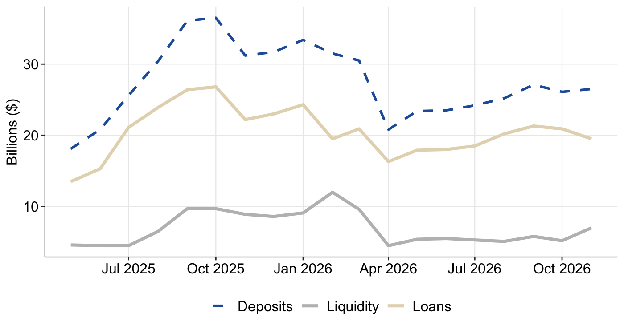
There are also multiple sources of yield within these on-chain financial systems. Some originate from the underlying asset itself, such as interest generated by tokenized government securities or rental income from tokenized real estate. Others are generated through DeFi activities, including lending interest paid by borrowers, liquidity provision fees and protocol incentives.
Composability and On-Chain Financial Activity
Beyond lending and borrowing, blockchain infrastructure introduces composability, allowing different financial applications to interact and build upon one another. Rather than operating through separate financial intermediaries and systems, financial products can be connected through smart contracts to support additional services and investment strategies.
An example is Curve Finance, which allows a diversity of tokens to interact within decentralized liquidity pools. Curve's ecosystem has expanded to accommodate tokenized real-world assets, allowing them to interact with other assets within DeFi. Investors can deposit tokenized assets into these pools to provide liquidity, earn trading fees and access additional on-chain yield opportunities.
This allows tokenized assets to become part of a larger financial ecosystem. An asset can generate income through its underlying structure, be used as collateral in a lending market, and interact with other applications that facilitate additional financial activity. In traditional finance, these functions are often managed through separate institutions, intermediaries and financial systems. However, on-chain infrastructure creates the possibility of connecting these activities through interoperable protocols and programmable smart contracts.
Looking Ahead
DeFi protocols are expanding beyond crypto-native products, while the tokenization of real-world assets (RWAs) is creating demand for an entirely new financial infrastructure that supports permissionless 24/7 trading and composability of financial products.
In our previous article, we discussed how tokenized real-world assets, including commodities and real estate, have experienced significant growth in recent years and are becoming an important part of DeFi. Now, these same assets are being utilized on-chain to generate yield, access liquidity through productive collateral and connect with other financial applications, changing how capital can be deployed.
Resources
Disclaimer
The services and products offered by RAAC discussed herein are not available to U.S. persons. This blog post is not intended to offer or to promote the offer or sale of these products and services in the United States or to U.S. persons.